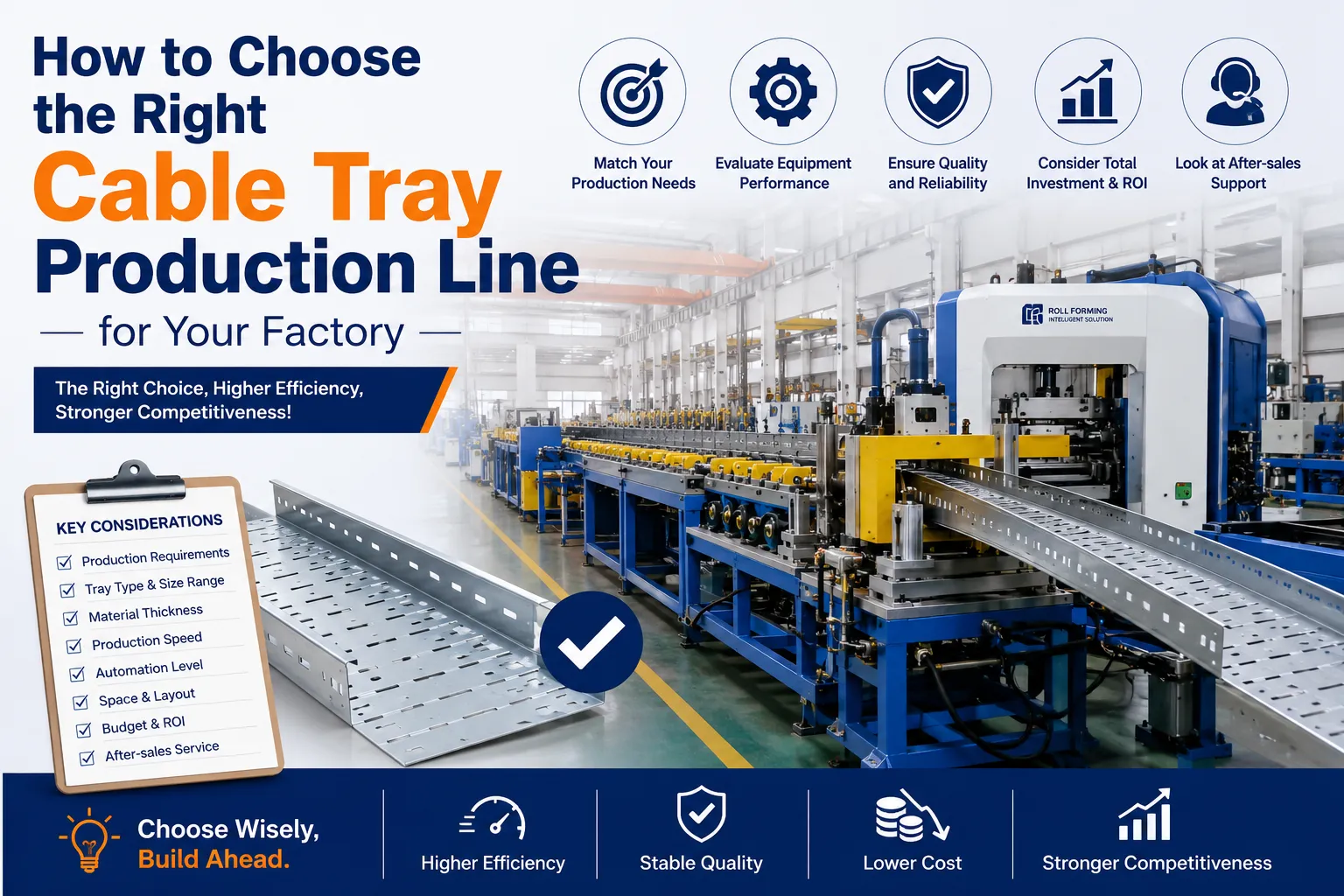
Investing in a cable tray production line is a major capital decision for any modern manufacturing facility. The machinery you choose today will dictate your factory’s output capacity, labor overhead, product quality, and market competitiveness for the next decade.
With global infrastructure, data center construction, and industrial automation booming, the demand for high-quality cable management systems is at an all-time high. However, selecting the wrong roll forming equipment can lead to rigid production limits, frequent downtime, and wasted material.
To ensure a high return on investment (ROI) and a future-proof factory floor, here is a comprehensive guide on how to choose the right cable tray roll forming machine and production line.
1. Analyze Your Core Product Specifications
The first rule of procurement is that your machinery must mirror your product catalog. Cable trays come in vastly different profiles, and a single machine cannot produce every type efficiently. Define the following parameters before contacting manufacturers:
Tray Profiles: Will you specialize in perforated cable trays, cable ladder trays, or solid-bottom cable trunking? Perforated trays require continuous punching, while ladder trays require secondary welding or structural clinching systems for the rungs.
Material Thickness: Standard commercial trays range from 1.0 mm to 2.0 mm, while heavy-duty industrial or marine-grade trays require thicknesses up to 2.5 mm or 3.0 mm. Ensure the machine’s motor torque, shaft diameters, and roller stations are rated for your heaviest gauge steel.
Material Type: Are you processing Cold Rolled Steel, Pre-Galvanized Steel, Stainless Steel, or Aluminum? Harder materials require specialized roller treatments to prevent surface scratching and premature wear.
2. Prioritize Width Flexibility: Manual vs. Automatic Changeover
Cable trays are highly customized products, with standard widths ranging from 100 mm to 600 mm, and side heights from 50 mm to 150 mm. How your machine handles these dimension changes is the biggest factor in your daily efficiency.
Manual Spacer Changeover: Traditional, budget-friendly machines require operators to manually change spacers and rollers on the shafts. This process can take 2 to 4 hours per size change, rendering short-run custom orders highly unprofitable.
Automatic PLC Width-Adjustment: Premium lines utilize a cantilever or cassette-type design driven by a servo motor. By typing the desired dimensions into a touchscreen panel, the rollers automatically adjust to the new width and height in under 10 minutes. If your market demands high customization and fast lead times, automated adjustability is a non-negotiable feature.
3. Match Production Speed with Material Handling Automation
Machinery cost scales directly with speed and automation. Balancing your budget with your required output is crucial.
Entry-Level Systems (4–8 m/min): These systems typically use a stop-and-punch hydraulic mechanism and a stop-to-cut shear. While highly affordable, the constant stopping limits throughput. They are best suited for smaller factories or localized markets.
High-Output Systems (10–15+ m/min): These lines feature a continuous servo-driven mechanical press for punching and a tracking flying shear for cutting. The sheet never stops moving, maximizing efficiency.
End-of-Line Automation: At 15 meters per minute, manual offloading creates a bottleneck. High-speed lines should be paired with automated magnetic stacking systems or robotic packing arms to reduce manual labor costs.
The Anatomy of a High-Performance Line
A truly turnkey cable tray production line must integrate seamlessly from start to finish. Ensure your vendor provides a cohesive layout consisting of:Hydraulic Decoiler —- servo feeder and Leveling—- Punching and Cutting —- Conveying platform —- Forming —- Out table
4. Inspect Component Quality and Build Rigidity
A machine is only as reliable as its weakest component. To minimize maintenance costs and guarantee precision, audit these technical specifications:
Roller Material: Insist on premium tool steel like Cr12MoV (D2) or GCr15 bearing steel. The rollers must undergo vacuum heat treatment to achieve a hardness of HRC 58-62. Inferior steel will deform under the abrasive friction of galvanized coatings, ruining profile accuracy.
Drive Transmission: For processing steel thicker than 1.5 mm, avoid cheap chain drives. Opt for an independent gear box drive or universal joint transmission. This ensures uniform torque across all forming stations, preventing sheet slippage and twist.
Control System Architecture: Ensure the PLC, HMI touchscreen, and frequency inverters are from globally recognized brands like Siemens, Mitsubishi, or Yaskawa. If a control module fails, sourcing a local replacement prevents weeks of catastrophic customs delays.
Partner with the Right Manufacturer
Choosing the right cable tray production line isn’t just about buying a piece of hardware; it’s about choosing a technical partner. Look for manufacturers that offer comprehensive factory layout planning, overseas installation assistance, and lifetime software updates for the PLC systems.
By prioritizing automated width adjustment, robust roller metallurgy, and continuous punching configurations, your factory will achieve lower production costs per meter, immaculate product straightness, and the agility to win high-volume commercial contracts.
Ready to Upgrade Your Factory’s Production?
We engineer high-speed, fully automated cable tray roll forming production lines tailored to your precise profile demands. Cut your changeover times, eliminate manual labor bottlenecks, and scale your output today.
Request a custom machinery quote and factory layout blueprint