In modern industrial, commercial, and infrastructure developments, managing thousands of electrical cables safely and efficiently is a critical challenge. The backbone of this management is the humble yet highly engineered cable tray.
For project managers, procurement specialists, and electrical engineers, choosing the right cable tray vendor isn’t just about price—it’s about structural integrity, compliance, and life expectancy. To help you make an informed sourcing decision, let’s go behind the scenes.
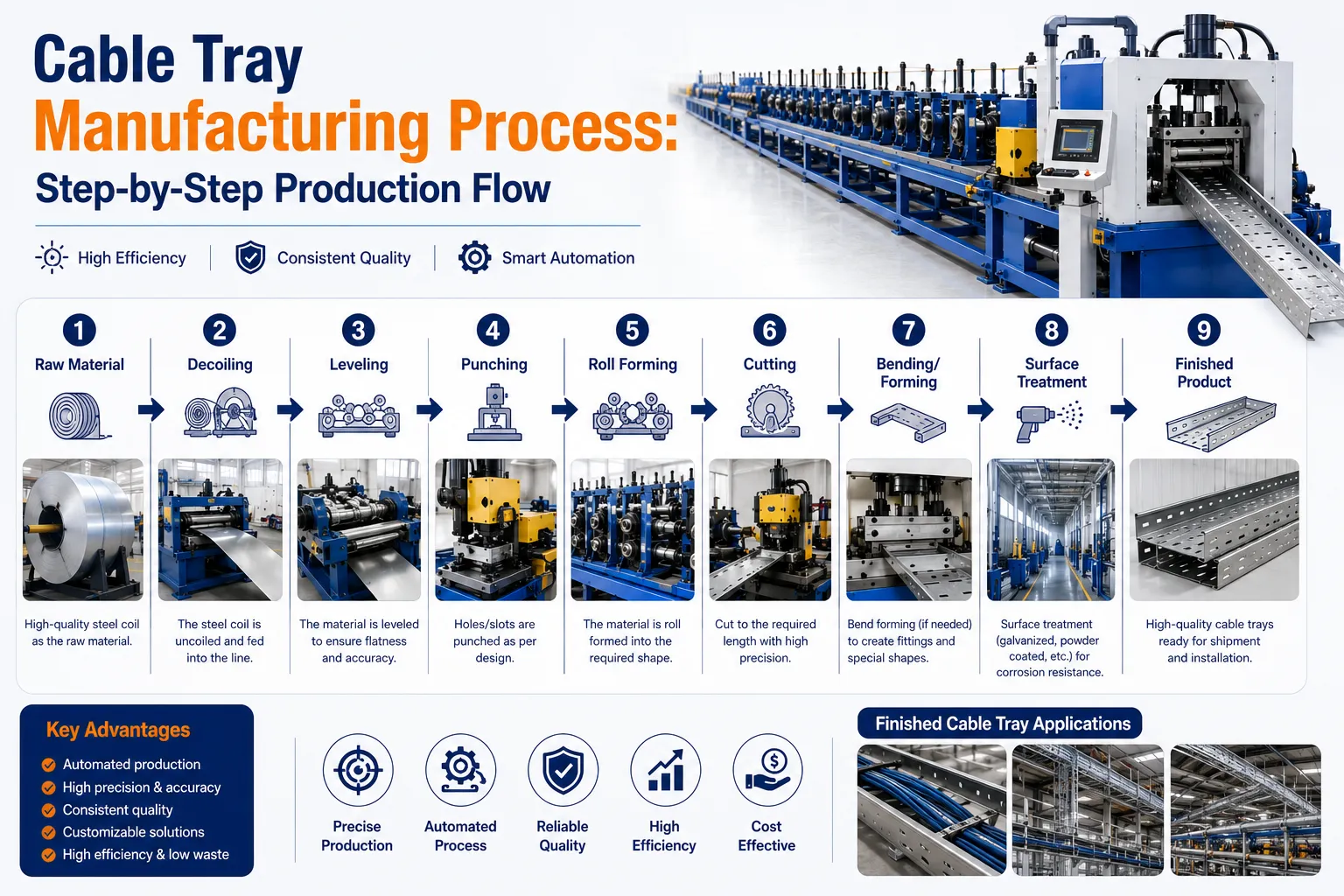
Here is the comprehensive, industry-standard cable tray manufacturing process and step-by-step production flow that guarantees high-performance electrical containment systems.
Why the Manufacturing Process Matters to Your Bottom Line
Before diving into the machinery, it is important to understand why the production flow matters. A flawed manufacturing process leads to uneven metal thickness, sharp burrs that cut cables, weak weld points, and poor zinc coating—all of which lead to structural failure and premature corrosion.
By contrast, a state-of-the-art automated cable tray production line ensures precision, reduces material waste, and guarantees that every single tray meets international safety standards like IEC 61537 and NEMA VE 1.
The Step-by-Step Cable Tray Production Flow
The fabrication of heavy-duty cable trays—whether they are perforated, solid bottom, or ladder types—requires a series of synchronized, heavy-duty mechanical processes. Below is the step-by-step workflow of modern manufacturing plants.
Step 1: Material Selection & Uncoiling
The process begins with selecting high-grade raw materials. Depending on the environment they will be deployed in, manufacturers typically use:
Carbon Steel (for standard industrial use)
Stainless Steel (SS304/SS316) (for marine or chemical environments)
Aluminum (for lightweight, corrosion-resistant applications)
The raw metal arrives at the facility in massive, tightly wound coils weighing several tons. These coils are loaded onto a heavy-duty De-coiler (uncoiler). The de-coiler rotates, smoothly feeding the raw metal sheet into the primary production line.
Step 2: Precision Leveling and Flattening
Metal that has been tightly coiled naturally retains a curve, known in the industry as “coil set.” Forcing curved metal into a shaping machine causes structural weaknesses. To fix this, the uncoiled steel passes through a leveling and flattening machine. A series of staggered rollers applies calculated pressure to eliminate internal stress, turning the curved sheet into a perfectly flat, uniform metal strip.
Step 3: High-Speed CNC Punching & Perforation
For perforated cable trays and ladder tray side rails, this is where the magic happens. The flat metal sheet passes under a high-precision CNC multi-station hydraulic punching press.
Ventilation Holes: Placed strategically to allow airflow, preventing cable overheating.
Connection Slots: Punched at the ends of the trays to facilitate fast, easy interlocking during on-site installation.
Weight Reduction: Carefully engineered patterns cut down on the tray’s weight without compromising its load-bearing capacity.
Step 4: Continuous Roll Forming
This is the heart of the cable tray manufacturing process. The flat, punched metal strip enters the Cable Tray Roll Forming Machine. Rather than bending the metal all at once (which cracks the steel), the strip passes through a consecutive series of highly calibrated rollers. Each set of rollers bends the metal by a few degrees. By the time it exits the final roller, the flat sheet has been flawlessly transformed into a 3D structural profile—usually a “U” shape or a “C” shape with returned flanges for added stiffness.
Step 5: Automatic Hydraulic Cutting-to-Length
Once the continuous profile is formed, it must be cut into standard commercial lengths (typically 2.4 meters, 3 meters, or 10 feet). A tracking hydraulic post-cutter handles this step. The cutter moves back and forth in perfect synchronization with the speed of the production line. This ensures a clean, burr-free cut without stopping the machinery, maintaining high production efficiency.
Step 6: Automated Assembly & Welding (For Ladder Trays)
If the production line is making ladder cable trays, the formed side channels and punched rungs are directed to an automated assembly station. Here, specialized robotic MIG welding or resistance welding secures the rungs to the side rails. Consistent, deep-penetration welds are vital here to ensure the ladder tray can support heavy high-voltage cables over wide spans.
Step 7: Post-Treatment & Surface Finishing
To ensure the cable trays survive decades of environmental exposure, they undergo a rigorous surface treatment process. The three most common finishes include:
Pre-Galvanized (GI): The raw material is already zinc-coated before processing—best for indoor commercial buildings.
Hot-Dip Galvanized (HDG): The completely fabricated tray is submerged into a bath of molten zinc at roughly 450°C (840°F). This creates a thick, self-healing, rust-resistant layer ideal for harsh outdoor or industrial environments.
Powder Coating / Thermosetting Epoxy: An electrostatic powder is sprayed onto the tray and baked in an oven, offering both color-coding capabilities and excellent chemical resistance.
Manufacturing Flowchart at a Glance
| Sequence | Production Stage | Primary Machinery | Core Objective |
| 01 | Raw Material Prep | De-coiler & Flattener | Feed and flatten raw metal coils smoothly. |
| 02 | Perforation | CNC Hydraulic Punch Press | Punch ventilation holes and connection slots accurately. |
| 03 | Structural Shaping | Roll Forming Mill | Gradually bend flat sheets into robust 3D profiles. |
| 04 | Sizing | Hydraulic Flying Shear | Cut continuous trays into precise, standard lengths. |
| 05 | Surface Protection | Hot-Dip Galvanizing / Powder Line | Apply anti-corrosion coatings for maximum lifespan. |
Critical Quality Control (QC) Checkpoints
Before packing and shipping, premium manufacturers execute three strict quality checks:
Dimensional Tolerance: Verifying thickness, width, and length down to the millimeter.
Burr & Sharp Edge Inspection: Ensuring all punched holes and cut edges are smooth to protect cables from insulation tearing during pulling.
Coating Thickness Measurement: Utilizing digital gauges to check that the zinc or powder layer meets micron-thickness specifications required by international standards.
Maximize Your Project Safety with Premium Cable Management
The quality of your cable tray determines the long-term safety of your facility’s electrical distribution. Partnering with a manufacturer that utilizes a fully automated, high-precision cable tray production flow guarantees that your project avoids installation delays, structural sagging, and premature corrosion.
Looking for a Reliable Cable Tray Manufacturer?
We specialize in high-capacity, international-standard cable tray manufacturing. From custom dimensions to bulk hot-dip galvanized orders, our state-of-the-art roll forming lines deliver uncompromised quality on tight schedules.
Contact Our Engineering Team Today to receive a rapid quote, request free product samples, or discuss the custom specifications for your next project!