
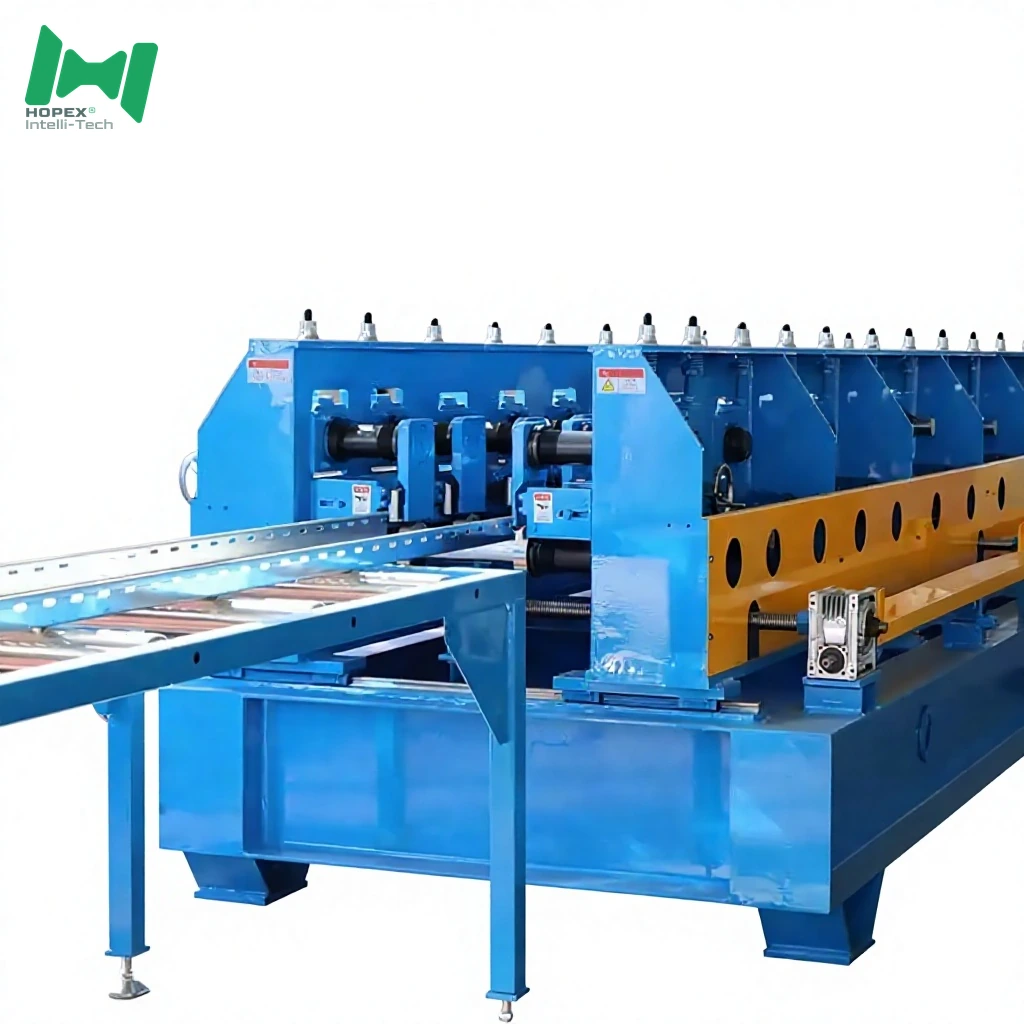
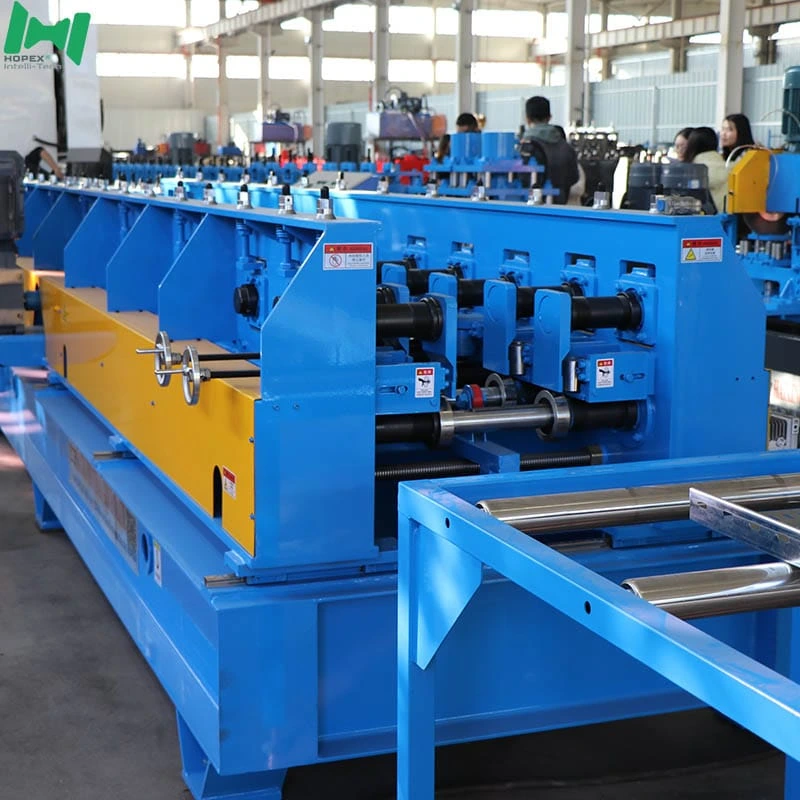
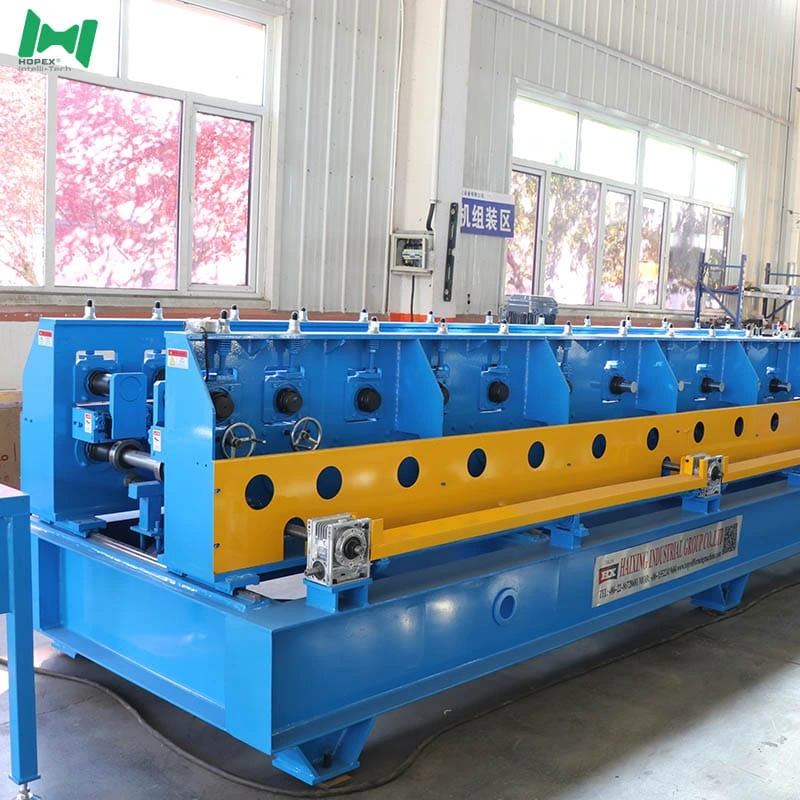
Heavy Duty Cable Tray Machine 100-600mm
Industrial-grade heavy duty cable tray machine producing 100–600 mm × 50–100 mm trays across eight standard sizes in 1.0–2.0 mm Q235 or galvanized steel. Combines a 6-tonne decoiler, an 11-roller leveler with servo feeding, a 200-tonne Yangli mechanical press with combination die, and a 22-pass forming mill driven by three 5.5 kW main motors — all inside a compact 35 × 1.5 × 1.6 m footprint at 60 kW installed. Built for petrochem, MV, data-centre and full-catalogue tray manufacturers.
Need a heavy duty cable tray machine built for the thicker end of the industrial spec sheet? This 100-600mm line handles what lighter tray lines cannot: 2.0 mm gauge across the full width range, 60 kW installed power, a 200-tonne Yangli press at the front, and three 5.5 kW main motors distributed across a 22-pass forming mill. Moreover, the front-end integrates 11-roller precision leveling with servo feeding — enough flattening headroom to keep 2.0 mm Q235 or galvanized strip flat through a dense hole pattern.
The line is designed for eight standard tray sizes off a single setup, ranging from a 100 × 50 mm branch tray to a 600 × 100 mm trunk tray, in a compact 35 × 1.5 × 1.6 m footprint. In short, it is the equipment specification factories reach for when the tender calls for heavy-perforation industrial cable trays in the thicker gauge band.
Three Numbers That Define This Heavy Duty Cable Tray Machine
Most cable tray lines top out at 40 kW installed power and single-motor mills. However, this heavy duty cable tray machine pushes every one of those ceilings higher:
1. 200-Tonne Yangli Press
The front-end press is a 200-tonne mechanical unit from Yangli — one of China’s largest and longest-established press manufacturers, based in Jiangsu. As a result, the press carries the punching load for dense hole patterns at 2.0 mm gauge without stalling. Additionally, Yangli spare-parts distribution reaches most industrial markets worldwide, so downstream service is not a bottleneck.
2. Triple-Drive Forming Mill
The 22-pass forming mill runs on three main motors of 5.5 kW each — distributed across the mill length rather than concentrated in a single drive point. Consequently, torque is delivered where the forming load actually is, not transmitted through a single long chain that stretches or slips.
3. 60 kW Installed Power
Total installed power is approximately 60 kW — a 50 % step up from typical 40 kW tray lines in the same width class. Furthermore, this headroom is what lets the line run 2.0 mm gauge continuously without motor thermal limits — a real bottleneck on undersized lines during full-shift production.
Heavy Duty Cable Tray Machine at a Glance
Yangli Press on This Heavy Duty Cable Tray Machine — Why the Brand Matters
At 200 tonnes stamping into 2.0 mm strip with a combination die, the press is the piece that either lasts or does not. Notably, this heavy duty cable tray machine ships with a press from Yangli Group (扬力集团) — a Jiangsu manufacturer founded in 1966, listed among China’s top mechanical-press producers, with export presence across Southeast Asia, the Middle East and South America.
Three practical advantages follow from that choice:
- Spare-parts availability — Yangli parts are stocked by dealers in most industrial export markets, not sourced only from a single OEM
- Documented life expectancy — mechanical presses at this tonnage class routinely deliver 15–20-year service lives when properly maintained
- Combination-die compatibility — the press is dimensioned for combination dies (punch + shear in one stroke), which is what enables single-stroke perforation-plus-cut on this line
Additionally, the press stroke is synchronised with the 11-roller servo feed downstream, so pattern registration between punched holes and cut length holds without operator intervention.
Eight Standard Sizes Off One Setup
The mill produces eight finished sizes on a single setup by combining four width settings and two side-height settings:
Furthermore, the automatic open/close motors (1.5 kW × 2) on the mill handle width preset changes from the HMI — moving between sizes is a stored recipe, not a mechanical shim strip-down.
Heavy Duty Cable Tray Machine — 11-Roller Leveler Geometry
Leveling is where a line either produces flat trays or wavy ones. Specifically, this heavy duty cable tray machine runs an 11-roller leveler configured as:
- 3 upper rollers
- 4 lower rollers
- 1 clamp-and-feed roller pair at the entry
- 1 clamp-and-feed roller pair at the exit
Consequently, the strip enters and exits the leveler under positive clamp control — no slippage, no wave development between the leveler and the press. Additionally, roller diameter is φ100 mm (larger than the typical φ70–80 mm), which spreads bending stress over a longer contact arc and reduces surface marking on galvanized coil.
The leveler is driven by a 4 kW motor and directly feeds the 200T press via servo pitch feeding.
Triple-Drive Forming Mill — Why Three Motors Instead of One
Single-motor mills concentrate torque at one drive point, then distribute it through a long chain. However, at 2.0 mm × 600 mm strip that chain becomes a mechanical liability — it stretches under load, slips at start-up, and demands frequent tension adjustments.
This mill runs three 5.5 kW main motors distributed across the 22-pass length. As a result:
- Torque is delivered where forming load is — no long chain runs
- Start-up is stable at full width — three motors share the initial breakaway load
- Chain wear stays low — each drive segment carries only its own passes
- Redundancy is real — one motor derated does not stop the line
Furthermore, each 5.5 kW motor runs an INVT inverter, so speed is matched across drives via the master HMI.
Heavy Duty Cable Tray Machine — Full Line Walk-Through
The line reads left to right in six stations:
6-tonne decoiler → 11-roller leveling + servo feeding → 200T Yangli press (punch + shear) → 3m high-speed conveyor → 22-pass forming mill → 3m run-out
1. Decoiler — 6-Tonne Hydraulic
The coil sits on a hydraulic expanding mandrel with electric drive. Inner diameter opens from φ460 to φ520 mm; outer diameter accepts up to φ1600 mm. Coil width intake is 200–1050 mm — wider than most tray decoilers, sized for the 850 mm max strip this line consumes.
2. Leveling + Servo Feeding
The 11-roller leveler (3 upper, 4 lower, 2 clamp pairs) with φ100 mm rollers and 4 kW drive flattens the strip. Additionally, servo pitch feeding delivers the strip to the press at the exact stroke position the combination die requires — no drift between punched hole positions and cut length.
3. 200T Yangli Press — Combination Die
The Yangli mechanical press stamps the ventilation or connection hole pattern via a combination die that punches and shears in one stroke. Consequently, dense multi-hole trays leave the press pre-cut, ready for forming.
4. High-Speed Conveyor — 3-Metre Powered
A 3-metre roller conveyor (1.5 kW main, 0.37 kW electric open/close) moves the sheared blank from the press to the mill. Notably, the conveyor lets the press and mill run out of phase, so a slow forming cycle does not hold the press cycle back.
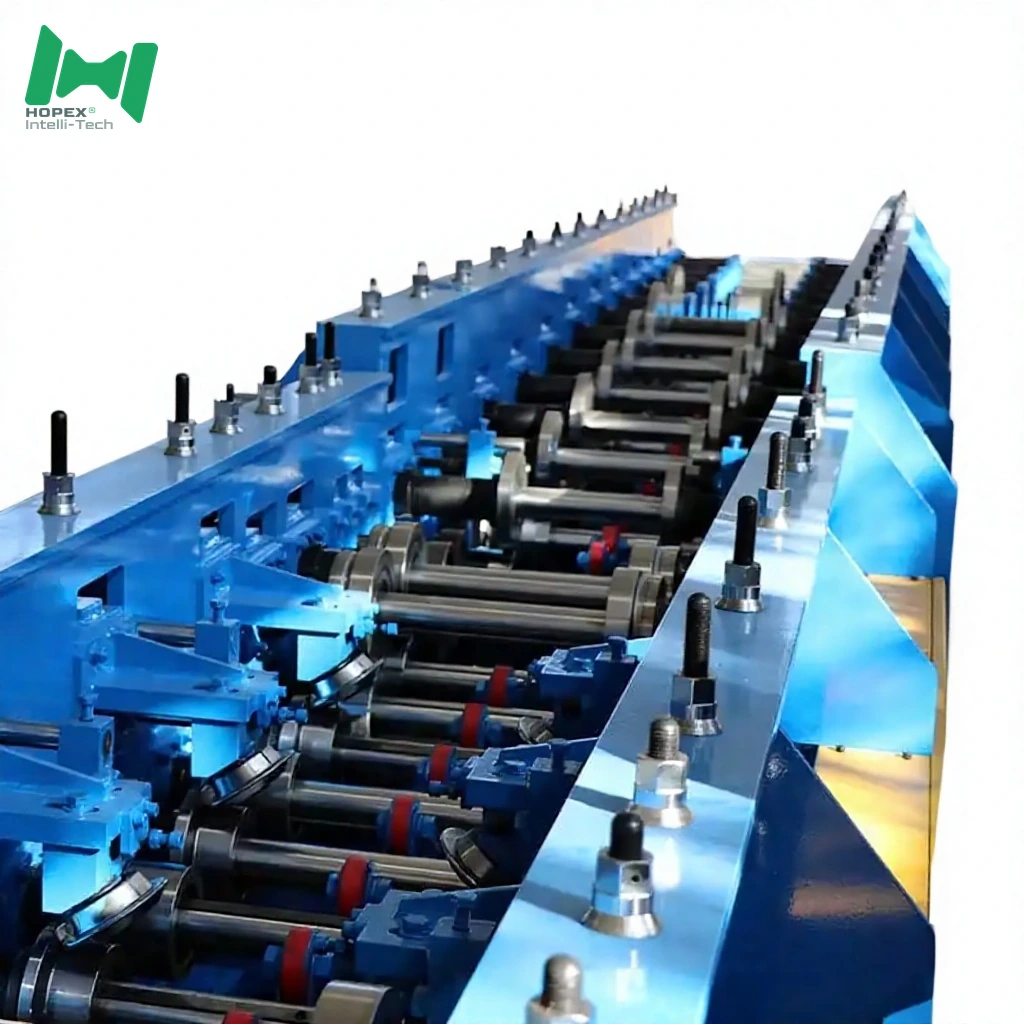
5. Roll Forming Mill — 22 Passes on φ65 mm Shaft
Twenty-two forming passes on the φ65 mm 45# steel shaft progressively raise the walls and finish the profile. Rollers are Cr12 tool steel. Drive is chain-based, distributed across three 5.5 kW main motors and two 1.5 kW open/close motors.
6. Run-Out Platform
A 3-metre passive idler run-out carries finished trays off the mill for pick-up or transfer.
Sourced Component Brands
Named parts. Therefore, spares are locally sourceable worldwide.
Note: brands listed cover main equipment. Auxiliary parts may vary by production batch; substitutions are disclosed at order confirmation.
Where the Heavy Duty Cable Tray Machine Fits Best
Because it handles heavy gauge, dense hole patterns, and full 6-metre workpieces at 60 kW installed power, this line suits fabricators serving industrial project categories:
Common Questions
What makes this a “heavy duty” cable tray machine?
Three things: 200-tonne press (versus 100–160 T on lighter lines), 60 kW installed power (versus 35–40 kW), and three distributed main motors on the forming mill (versus single-motor drives). Furthermore, the 11-roller leveler with clamp pairs and φ100 mm rollers is a heavier front-end than the 7- or 8-roller levelers on standard lines.
What is the actual production speed?
6–10 m/min — deliberately not faster. Additionally, at dense hole patterns the press cycle governs speed; at sparse patterns the mill governs. Line speed is inversely proportional to hole count per tray.
Why is the press branded Yangli, not generic?
Yangli is one of China’s oldest and largest mechanical-press manufacturers. Consequently, spare parts, technical documentation and service dealers are available in most industrial export markets — which matters more than raw tonnage when a press is expected to run 15+ years.
Why three main motors instead of one big one?
Distributed drives deliver torque where the forming load actually is. As a result, chain stretch is minimal, start-up breakaway is shared, and each 5.5 kW motor works within its comfort zone. A single 16.5 kW motor at the end of a long chain is mechanically simpler but wears faster.
How many finished sizes without a mechanical change?
Eight standard sizes by combining four width settings (100, 200, 300, 400, 600 mm) with two side-height settings (50 or 100 mm). The two 1.5 kW open/close motors handle width preset changes on the HMI.
What steel does the line handle?
Q235B cold-rolled and galvanized strip from 1.0 to 2.0 mm thick. The 200–1050 mm strip width band on the decoiler is what makes the 100–600 mm base-width envelope possible.
What is the tolerance on finished trays?
±1.5 mm on length and width, 90° ± 2° on corner angle. Notably, tolerance is looser than the ±1 mm on servo-cut lines because press-stamp cut-off carries slightly more variability at 2.0 mm gauge than a hydraulic shear.
What is the total footprint and power draw?
35 m long × 1.5 m wide × 1.6 m high, drawing approximately 60 kW installed on 380 V / 50 Hz / 3-phase. The narrow 1.5 m width means the line fits along a factory wall without demanding a dedicated bay.
Bottom Line
If your production plan calls for heavy-gauge, densely perforated industrial cable trays across eight standard sizes, this heavy duty cable tray machine is the equipment for it. It combines a 6-tonne decoiler, an 11-roller leveler with servo feeding, a 200-tonne Yangli mechanical press with combination die, and a 22-pass forming mill driven by three 5.5 kW main motors — all inside a 35 × 1.5 × 1.6 m footprint drawing approximately 60 kW installed.
For die drawings, hole-pattern intake, or a walk-through of the eight-size changeover on the HMI, contact our project team with your target sizes, hole layout, steel grade and monthly output. Then we configure the die, rollers and mill setup to your production plan. p to your production plan. production plan.