
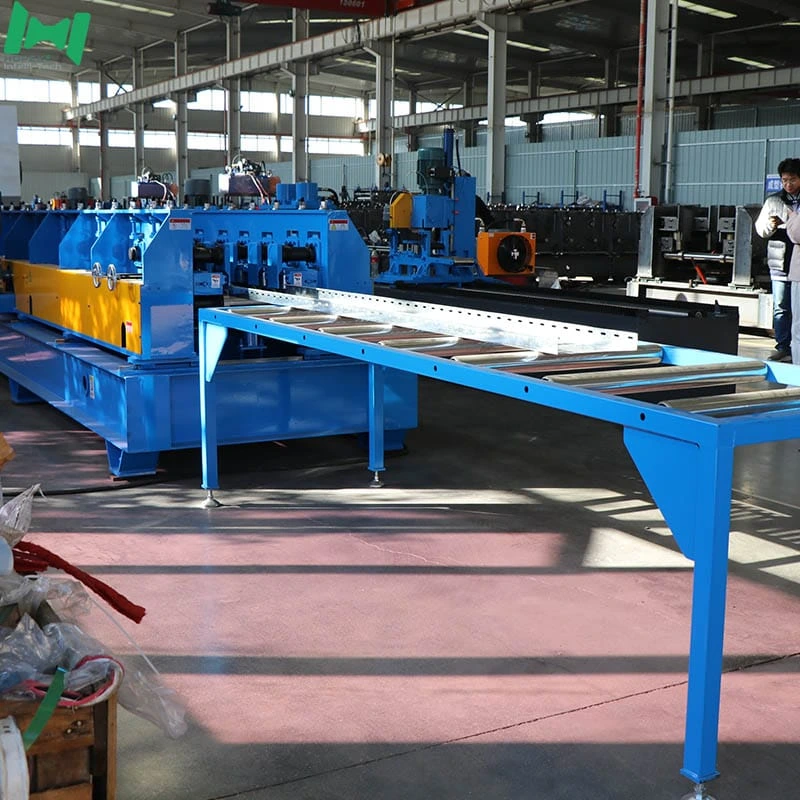
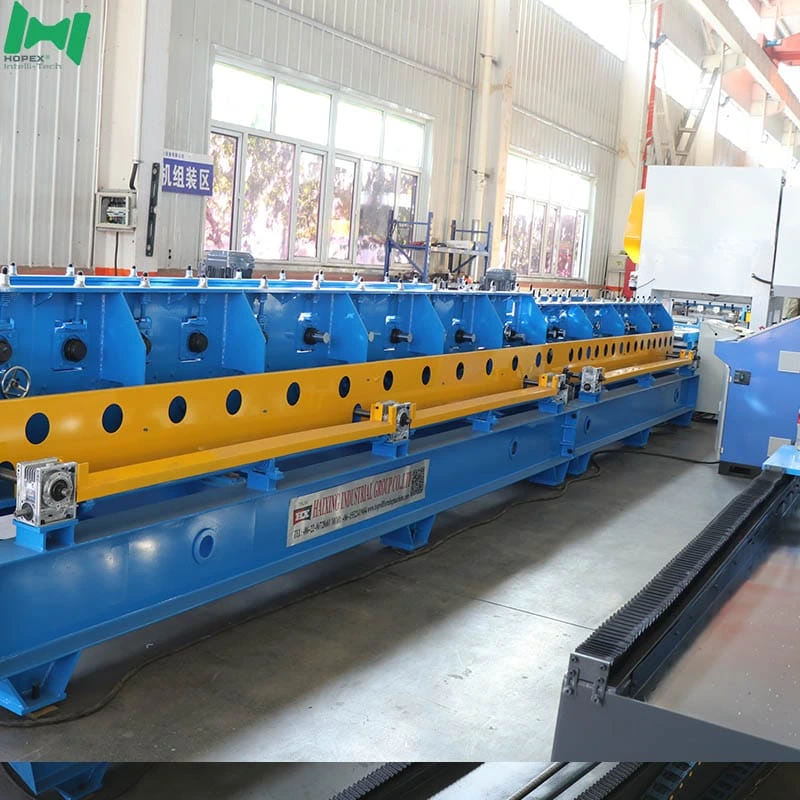
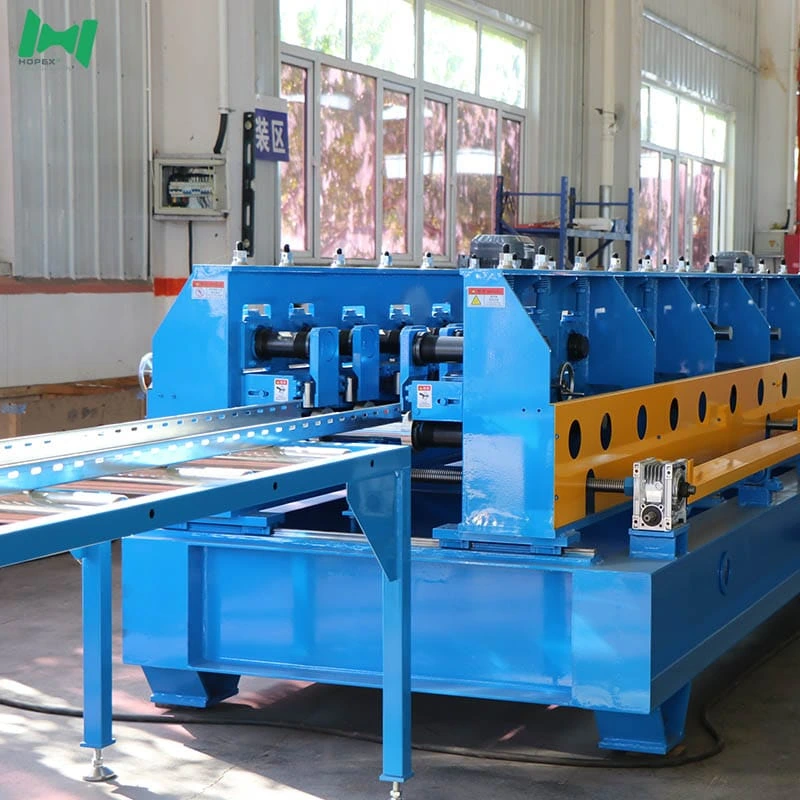
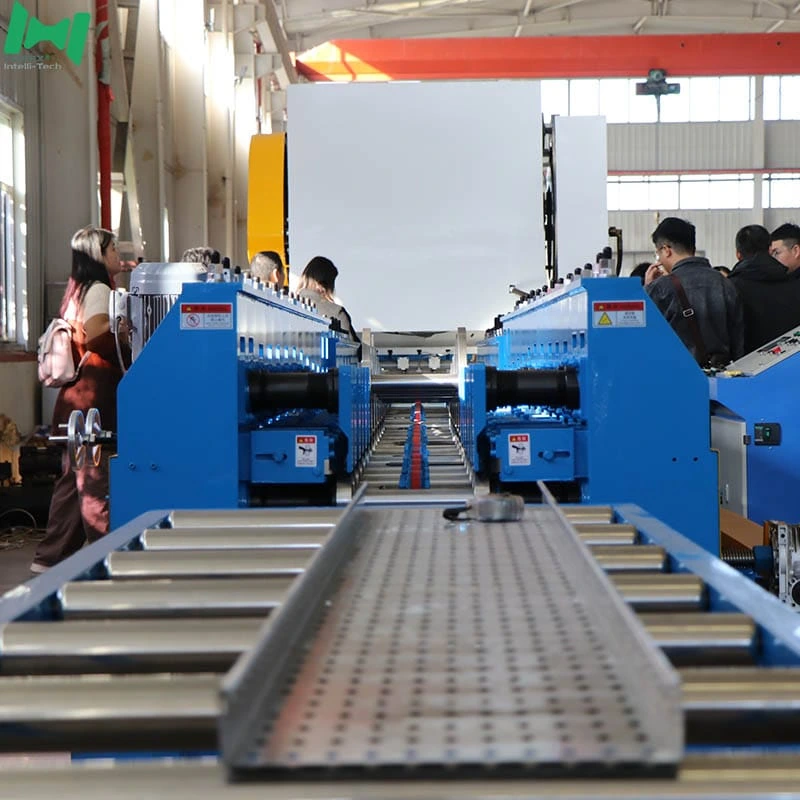
Cable Tray Roll Forming Mill 50-600mm
Stand-alone cable tray roll forming mill delivered as a self-contained forming module — not a full turnkey line — for factories that already own a decoiler, leveler and press. Handles 50–600 mm × 50–100 mm cable trays in 0.5–2.0 mm Q235 or galvanized steel across eight standard sizes, at 8–16 m/min. Runs a 26-pass mill on a φ65 mm shaft driven by three distributed 5.5 kW main motors, in a compact 10 × 1.5 × 1.6 m footprint drawing only 25 kW installed — small enough for L-shape or mezzanine layouts a full integrated line rules out.
Need a cable tray roll forming mill as a stand-alone forming module — not a full turnkey line — to pair with a decoiler, leveler and press you already own? This 50-600mm forming mill is exactly that: a 26-pass forming main machine on a φ65 mm shaft, driven by three 5.5 kW main motors, delivered as an independent unit ready to slot into an existing cable-tray production layout. Moreover, at just 10 metres long × 1.5 m wide × 1.6 m high and drawing only 25 kW installed, it fits into a factory bay where a full 35-metre integrated line would not.
The mill handles 0.5–2.0 mm Q235B cold-rolled or galvanized strip at 8–16 m/min, across 50–600 mm base width × 50–100 mm side height — covering the full standard cable tray envelope in a single forming section. In short, it is the forming half of a cable tray line, sold and delivered on its own for buyers who already have their front end sorted.
When You Need Just the Mill, Not the Full Line
Most cable tray production spending goes on the front end — decoiler, leveler, press, feeder. Consequently, a plant that already owns those pieces (or that runs shared front-end equipment across multiple product lines) does not need to buy them again for a new tray SKU. Furthermore, three buyer profiles benefit directly from a stand-alone cable tray roll forming mill:
- Existing tray manufacturers upgrading forming capacity — keep your press and decoiler, add a modern mill with three distributed drives
- OEMs and integrators — spec the forming module and assemble the full line yourself, matching customer front-end preferences
- Multi-product roll-forming shops — share one decoiler and press across several forming mills, running different SKUs off the same front end
As a result, capital outlay per finished-product line drops significantly compared with buying a full integrated line each time.
Cable Tray Roll Forming Mill at a Glance
Why 10 Metres of Footprint Matters
Full integrated cable tray lines run 30–40 metres end-to-end. However, most factory bays that were built before the tray-manufacturing category existed simply do not have that continuous linear space. Consequently, a stand-alone forming mill at 10 metres opens two practical layouts that a 40-metre line rules out:
- L-shaped production flow — press bay perpendicular to the forming mill bay, sharing a corner conveyor
- Second-floor mezzanine mill — press stays on the ground floor; formed profile discharges over a light-duty overhead conveyor
Additionally, the mill weight sits well below the load ratings of standard mezzanine floors, so it does not need reinforced foundations. In other words, the shorter footprint is not just floor-space arithmetic — it changes what layouts are practical.
How the Mill Slots Into an Existing Line
For the cable tray roll forming mill to work with an existing front end, three interfaces have to match. The mill is designed to be flexible on all three:
1. Mechanical Interface — Strip Entry
The mill’s infeed accepts a 150–850 mm wide strip at any thickness from 0.5 to 2.0 mm. Furthermore, entry height and centreline can be shimmed at commissioning to align with whatever leveler or feeder is upstream. Therefore, retrofitting into an existing conveyor line rarely requires structural changes.
2. Electrical Interface — Power and Control
Power supply is 380 V / 50 Hz / 3-phase — the standard for Chinese and most export industrial supplies. Additionally, the mill’s motor drives run INVT inverters communicating over standard Modbus, so integration into an existing PLC control network is straightforward. The mill can be operated stand-alone via its own inverter panel, or slaved to an upstream master PLC.
3. Speed Synchronisation
Line speed of 8–16 m/min is adjustable via the inverter — so the mill can match whatever pace an upstream press or shear dictates. Consequently, there is no throughput mismatch to design around at commissioning.
Three-Motor Distributed Drive Architecture
Single-motor cable tray mills concentrate torque at one drive point, then distribute it through a long chain across 26 forming passes. However, at 2.0 mm × 600 mm strip that chain becomes a mechanical liability — it stretches under load, slips at start-up and demands frequent tension adjustments.
This cable tray roll forming mill runs three 5.5 kW main motors distributed across the 26-pass mill length. As a result:
- Torque is delivered where forming load is — no long chain runs across the full mill
- Start-up is stable at full width — three motors share the initial breakaway load
- Chain wear stays low — each drive segment carries only its assigned passes
- Redundancy is real — one motor derated does not stop the mill
Furthermore, each 5.5 kW motor pairs with an INVT inverter, so speed is matched across drives via the master control panel or an upstream PLC command.
Standard Size Envelope on This Mill
The mill’s 50–600 mm width range and 50–100 mm height range yields eight standard tray sizes off a single setup:
Additionally, the automatic open/close motors (1.5 kW × 2) handle width preset changes from the HMI or the upstream PLC — moving between sizes is a stored recipe, not a mechanical strip-down.
Mill Anatomy — What’s Inside the 26 Passes
The mill breaks down into three functional zones:
Entry Zone — Passes 1–8
The first eight passes gently pre-shape the strip: raising the wall angle from flat toward 45°, forming the small-edge geometry, and beginning the base radius. Consequently, work-hardening happens gradually — no stress marks on the outside surface.
Main Forming Zone — Passes 9–20
The middle twelve passes do the heavy lifting: raising the walls from 45° toward vertical, seating the side reinforcing rib geometry, and locking in wall angle. Furthermore, this is where the second and third main motors deliver their torque.
Finish Zone — Passes 21–26
The last six passes finalise wall angle at 90° ± 2°, level the small edge, and set the base flatness. Additionally, opposing rollers in the last passes seat the profile cleanly without spring-back.
Rollers throughout are Cr12 tool steel; the main shaft is φ65 mm 45# steel — the same material specifications used on the fully integrated 50–600mm line.
Cable Tray Roll Forming Mill Component Brands
Named parts. Consequently, spares for this cable tray roll forming mill are locally sourceable worldwide.
Note: brands listed cover main equipment. Auxiliary parts may vary by production batch; substitutions are disclosed at order confirmation.
Stand-Alone Mill vs Full Integrated Line
If you are choosing between this stand-alone forming mill and a full integrated cable tray line, here is the practical split:
In other words, the stand-alone mill is the right choice when the front-end infrastructure is already in place. The full integrated line is the right choice when starting from a clean slate.
Common Questions
What exactly is a cable tray roll forming mill, versus a full line?
The mill is the forming main machine only — the 26-pass roll former that turns a punched, sheared blank into a finished cable tray profile. In contrast, a full line includes the decoiler, leveler, press, feeder, conveyor, mill, run-out and hydraulic station as one integrated package. This product is the mill alone.
Can I run this cable tray roll forming mill without a preceding press?
Only if you supply pre-formed blanks yourself. Furthermore, the mill has no punching or shearing station — it expects a pre-punched, pre-sheared blank fed in from an upstream operation, whether that is a press, a manual pre-shear, or another supplier’s finished blanks.
What sizes can it form?
Eight standard sizes by combining four width settings (50, 200, 300, 400, 600 mm) with two side-height settings (50 or 100 mm) — from a 50 × 50 mm micro tray to a 600 × 100 mm trunk tray.
What steel can it handle?
Q235B cold-rolled and galvanized strip from 0.5 to 2.0 mm thick, in strip widths from 150 to 850 mm. Notably, hot-rolled is not on the standard feedstock list for this mill; if hot-rolled compatibility is required, choose the fully integrated 50–600mm line instead.
How fast does the mill run?
8–16 m/min, adjustable via the inverter. Actual speed depends on what the upstream press or feeder can sustain — the mill is designed to match the front-end pace, not dictate it.
Why three 5.5 kW main motors instead of one big motor?
Distributed drives deliver torque where the forming load actually is. As a result, chain stretch is minimal, start-up breakaway is shared across three motors, and each 5.5 kW motor works within its comfort zone rather than being pushed to its thermal limit.
Can width changes be controlled from an existing PLC?
Yes. The 1.5 kW × 2 automatic open/close motors accept Modbus commands from an upstream PLC, or they can be driven from the mill’s own inverter panel. Consequently, width presets can be triggered as part of an upstream production recipe.
What is the total footprint and power draw?
10 m long × 1.5 m wide × 1.6 m high, drawing approximately 25 kW installed on 380 V / 50 Hz / 3-phase. The compact footprint is what makes non-linear plant layouts (L-shape, mezzanine) practical.
Bottom Line
If your factory already runs a decoiler, leveler and press — and you need to add or upgrade forming capacity for a 50–600 mm × 50–100 mm cable tray SKU — this stand-alone cable tray roll forming mill is the right module. It delivers a 26-pass mill on a φ65 mm shaft, driven by three distributed 5.5 kW main motors, at 8–16 m/min across 0.5–2.0 mm cold-rolled or galvanized steel, all in a 10 × 1.5 × 1.6 m footprint drawing just 25 kW installed.
For mechanical interface drawings, PLC integration documentation, or a walk-through of how this mill slots into your existing front end, contact our engineering team with your target sizes, upstream equipment details, steel grade and monthly output. Then we configure the roller tooling, drive synchronisation and control interface to your production plan. your production plan.