
Ventilated Cable Tray Machine 100-600mm
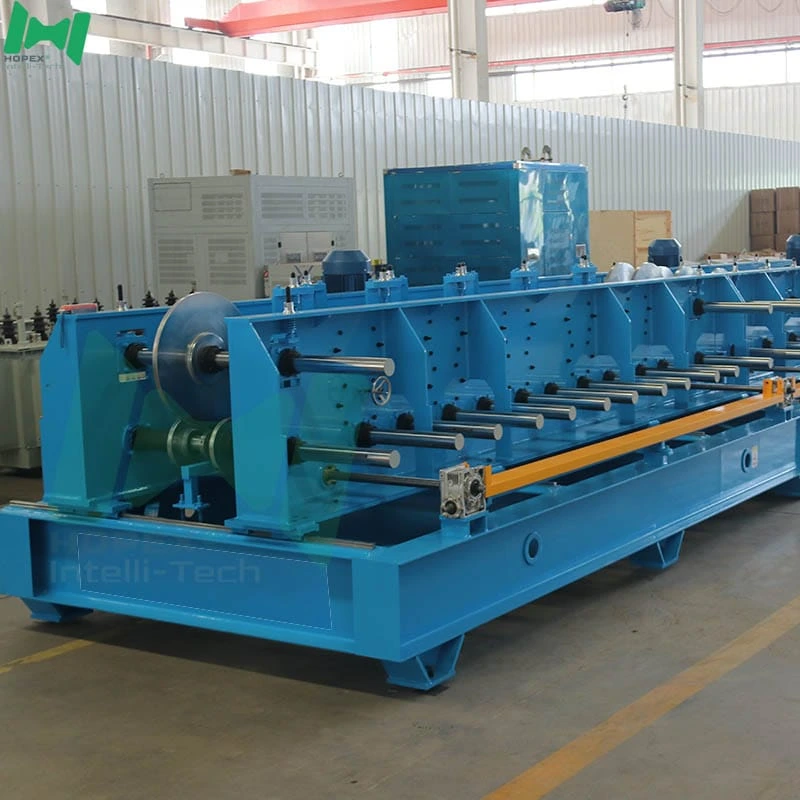
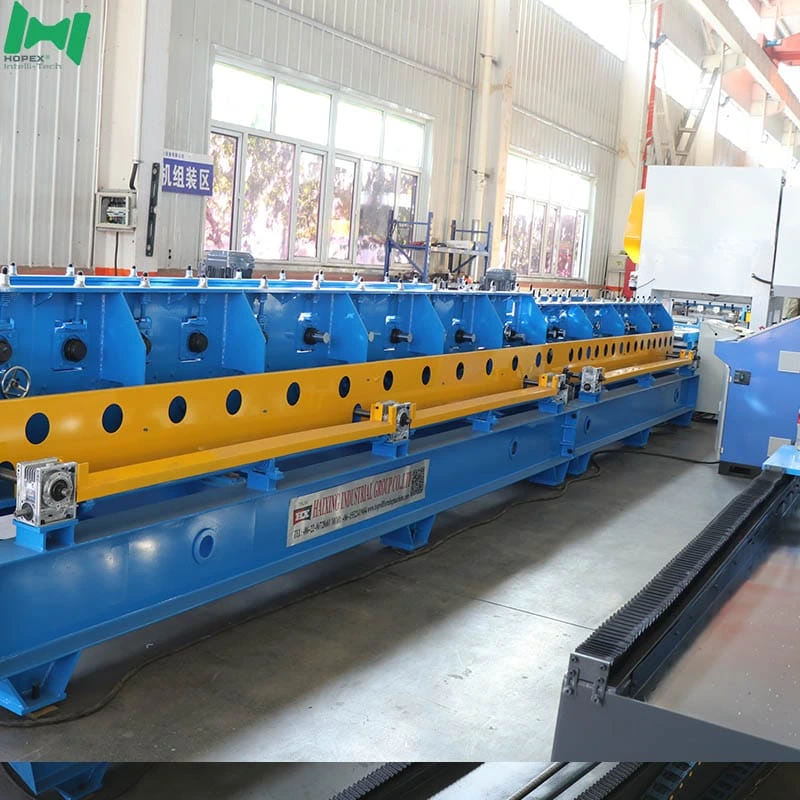
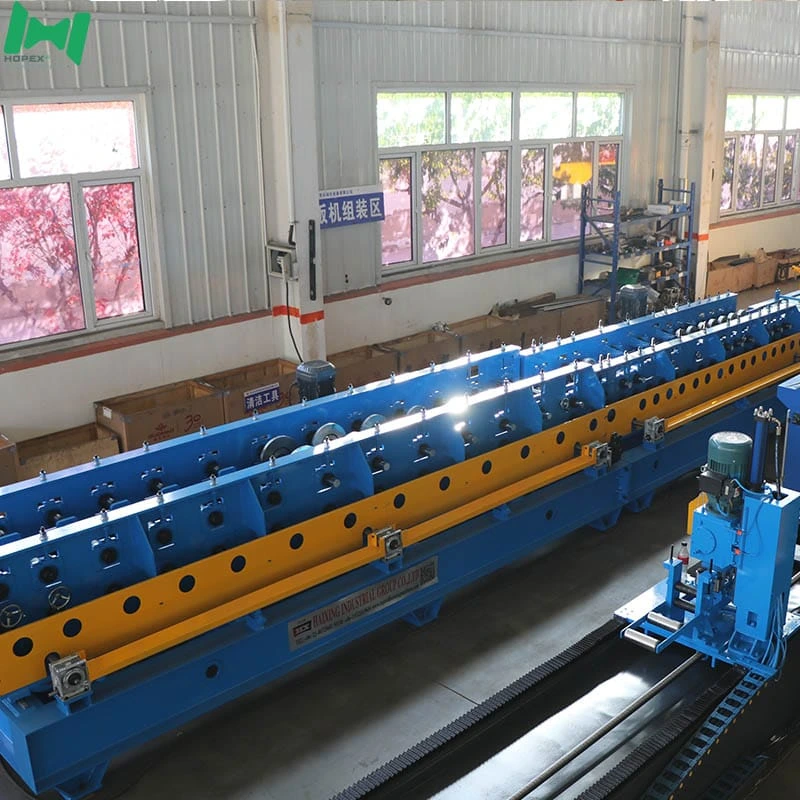
Press-led ventilated cable tray machine producing dense multi-hole trays for data centres, solar/BESS projects and outdoor substations. Covers eight standard sizes from 100 × 50 mm to 600 × 100 mm in 1.0–2.0 mm Q235B or galvanized steel. Features a 200-tonne Yangli press with combination die (full pattern punched in one stroke), 11-roller servo leveler, 22-pass forming mill with three 5.5 kW distributed motors, and workpiece lengths up to 6000 mm. IEC 61537 / NEMA VE 1 compliant tray geometry. 60 kW installed, 380 V / 50 Hz / 3-phase, 35 × 1.5 × 1.6 m footprint.
Ventilated cable trays are not a preference — in data centres, outdoor substations and solar power plants, they are a specification. This ventilated cable tray machine is built specifically for that job: a 200-tonne Yangli press with a combination die stamps dense hole patterns into 1.0–2.0 mm Q235B or galvanized strip in one downward stroke, then a 22-pass forming mill on a φ65 mm shaft with three 5.5 kW motors rolls the profile to size. Moreover, the result is a ventilated cable tray with consistent hole geometry across every piece in the production run.
The line covers eight standard tray sizes from 100 × 50 mm to 600 × 100 mm, holds ±1.5 mm tolerance on length and width, and runs at 6–10 m/min — the right speed for dense hole layouts where press cycle, not mill speed, governs throughput. In short, it is the equipment specification for fabricators who supply high-volume ventilated cable trays to heat-sensitive projects.
Why Ventilation Holes Are Not Cosmetic
Solid-bottom cable trays are cheaper to produce and simpler to specify. However, ventilated trays exist because cable heat is a real engineering constraint — not a detail. Notably, three standards drive the specification:
IEC 61537 — Cable Tray Systems
IEC 61537 classifies cable trays by perforation and requires that the classification match the installation environment. Furthermore, ventilated trays are mandated in environments where heat accumulation degrades cable insulation — including data-centre server rooms, battery storage racks and PV inverter areas.
NEMA VE 1 — Metal Cable Tray Systems
The NEMA VE 1 standard assigns fill-ratio derating factors for solid-bottom versus ventilated trays. Specifically, a ventilated tray allows a higher fill ratio without derating cable current capacity. As a result, specifiers on North American projects can run more cables per tray when the tray is ventilated — directly reducing the number of tray runs and support structures.
Solar and Battery Storage Projects
Photovoltaic and battery energy storage projects generate significant cable heat at the combiner box and inverter output. Consequently, cable management in these areas is routinely specified in ventilated galvanized tray, with hole patterns that maximise natural convection across horizontal runs.
Ventilated Cable Tray Machine at a Glance
Combination Die — One Stroke, Maximum Hole Density
The hole pattern on a ventilated cable tray is what separates an engineered product from a cosmetic one. Furthermore, achieving high hole density at 2.0 mm gauge requires a specific punching approach — and this ventilated cable tray machine uses the right one.
Inline hydraulic punching (common on tray lines below 150 T) stamps one hole at a time, which limits pattern density because the strip must advance between each stroke. Consequently, maximum hole density is governed by strip advance speed, not tooling.
Combination die on a 200T press stamps the entire hole pattern for one tray section in a single downward stroke. As a result:
- Maximum hole density is set by the die layout, not by line speed
- Edge quality is consistent across all holes in the pattern — no progressive fatigue on repeat-stroke tooling
- Registration is perfect — all holes in a pattern are punched simultaneously, so spacing is die-accurate, not feeder-accumulated
Additionally, the Yangli 200-tonne press delivers the sustained tonnage that 2.0 mm dense-pattern punching demands across a full shift without derating.
Eight Sizes for a Full Ventilated Cable Run
A complete ventilated cable management system needs multiple tray widths — from backbone trunk runs to equipment-level branch runs. This ventilated cable tray machine produces eight standard sizes from one setup:
Furthermore, the two 1.5 kW automatic open/close motors handle width preset changes from the HMI — a stored recipe change between 100 mm and 600 mm trays, not a mechanical shim job.
Data Centre Cable Management — The Ventilated Tray Specification
Modern data centres separate hot and cold airflow aisles. Consequently, cable trays above server racks sit in the hot aisle return path — an environment where solid-bottom trays trap heat against cable insulation and accelerate ageing. Therefore, specifications for cable trays above server aisles routinely require:
- Ventilated bottom (slotted or perforated) for airflow through the tray
- Galvanized or stainless steel for corrosion resistance in high-humidity CRAC-cooled rooms
- Consistent hole pitch for predictable airflow modelling in ASHRAE A1–A4 environments
- 6-metre workpiece length to span full server rows without splices above live equipment
This ventilated cable tray machine produces all four — the 200T combination die delivers consistent hole geometry; the galvanized feedstock is approved; 6-metre workpieces ship standard; and the 11-roller leveler keeps strip flat enough for pitch-accurate punching.
The 11-Roller Leveler — Why It Matters for Dense Hole Layouts
Punching a dense hole pattern into wavy strip produces two failure modes: edge tear at holes near the strip edge, and pitch drift as the strip springs between holes. Furthermore, both failures are invisible until the die closes — making a well-leveled strip the only prevention.
This ventilated cable tray machine carries an 11-roller leveler configured as:
- 3 upper rollers
- 4 lower rollers
- 1 clamp pair at entry
- 1 clamp pair at exit
Consequently, the strip enters and exits the leveler under positive clamp control. Additionally, roller diameter is φ100 mm — larger than the φ70–80 mm typical of lighter tray lines — which spreads bending stress over a longer contact arc and produces a flatter output at 2.0 mm gauge.
Full Line Walk-Through
The line reads left to right in six stations:
6-tonne decoiler → 11-roller leveler + servo feeder → 200T Yangli press (combination die) → 3m conveyor → 22-pass mill → 3m run-out
1. Decoiler — 6-Tonne Hydraulic
Hydraulic expanding mandrel with electric drive. Inner diameter opens from φ460 to φ520 mm; outer diameter accepts up to φ1600 mm; strip width intake 200–1050 mm. Because payoff is powered, heavy 2.0 mm galvanized coil pays out without tension spikes that would distort hole spacing.
2. Leveling + Servo Feeding
The 11-roller leveler flattens the strip across three reverse-bend pairs plus entry and exit clamp rollers. Furthermore, the servo feeder (4 kW) advances the strip to the press at the exact stroke position — so hole-pattern registration is die-accurate, not feeder-approximated.
3. 200T Yangli Press — Combination Die
The Yangli 200-tonne mechanical press closes the combination die in one stroke — punching the full ventilation hole pattern and shearing the blank simultaneously. Consequently, hole-to-hole spacing and hole-to-cut registration are both die-set, not accumulated by repeat feeder cycles.
4. Conveyor — 3-Metre Powered
A 3-metre roller conveyor (1.5 kW main, 0.37 kW electric open/close) moves the sheared, pre-punched blank from the press to the mill. Because the conveyor decouples press and mill cycle, the press can run at the optimal stroke rate without waiting for the mill.
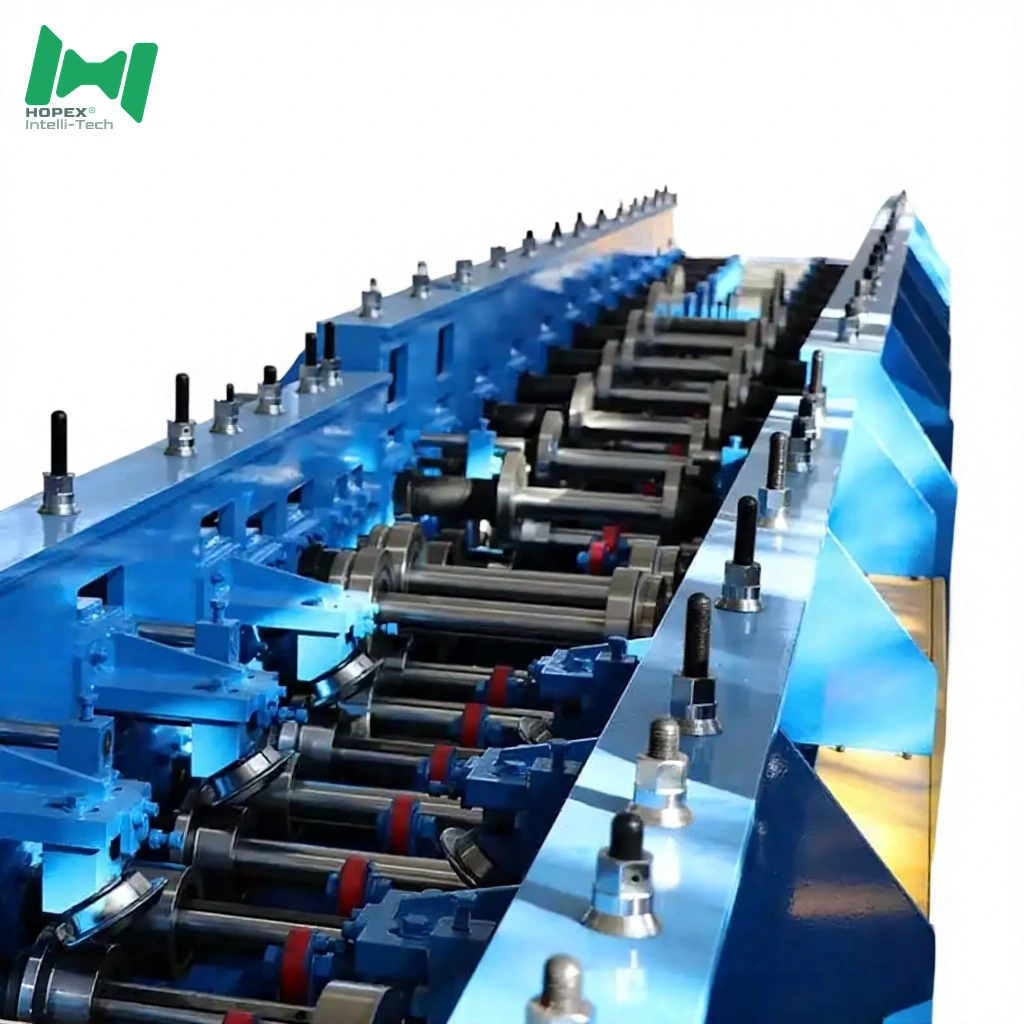
5. Roll Forming Mill — 22 Passes on φ65 mm Shaft
Twenty-two passes on the φ65 mm 45# steel shaft with Cr12 rollers and three distributed 5.5 kW motors form the punched blank into the finished ventilated tray profile. Width preset is handled by two 1.5 kW open/close motors from the HMI.
6. Run-Out Platform
A 3-metre passive idler run-out discharges finished ventilated trays for bundling or crane-lift.
Sourced Component Brands
Named parts. Therefore, spares for this ventilated cable tray machine are locally sourceable worldwide.
Note: brands listed cover main equipment. Auxiliary parts may vary by production batch; substitutions are disclosed at order confirmation.
Where a Ventilated Cable Tray Machine Earns Its Keep
Because it produces dense hole patterns at 2.0 mm gauge across eight standard sizes, this line suits fabricators serving heat-sensitive project categories:
Common Questions
Why use a 200T press instead of inline hydraulic punching for ventilated trays?
Inline hydraulic punching is limited by stroke rate and pattern density — each hole requires one stroke, so dense patterns slow the line dramatically. Furthermore, at 2.0 mm gauge, repeated partial-stroke hydraulic punching fatigues the strip edge between holes. In contrast, the 200T Yangli press with combination die stamps the full pattern in one stroke, keeping hole density and edge quality independent of line speed.
What hole patterns can it produce?
The hole pattern lives entirely in the combination die. Therefore, slotted ventilation holes, round holes, oblong holes, and end-connection holes are all achievable by die design — changing the pattern means changing the die, not the line.
What workpiece length can it produce?
Up to 6000 mm. Consequently, one ventilated tray spans a full server row above a hot aisle, or a full bay in an outdoor substation — no splice above live equipment.
What is the actual production speed?
6–10 m/min, governed by the press stroke rate. Denser patterns pull toward 6 m/min; sparse layouts run near 10 m/min. Additionally, the mill is designed to match this speed — neither the mill nor the press is the bottleneck on the other.
How many sizes can this ventilated cable tray machine produce?
Eight standard sizes: 600 × 100, 600 × 50, 400 × 100, 400 × 50, 300 × 100, 300 × 50, 200 × 100, and 100 × 50 mm. Width changes are a HMI recipe preset via the 1.5 kW × 2 open/close motors.
What steel grades does it handle?
Q235B cold-rolled and galvanized strip from 1.0 to 2.0 mm thick. Galvanized is the standard for ventilated trays in data centre and solar projects; Q235B cold-rolled is the baseline for standard commercial work.
What is the footprint and power draw?
35 m long × 1.5 m wide × 1.6 m high, drawing approximately 60 kW installed on 380 V / 50 Hz / 3-phase. The narrow 1.5 m width means this ventilated cable tray machine fits along a factory wall without requiring a dedicated bay.
Bottom Line
If your production plan calls for dense-hole ventilated cable trays across eight standard sizes from 100 × 50 mm to 600 × 100 mm, at 1.0–2.0 mm gauge, this ventilated cable tray machine is built for it. It combines a 6-tonne decoiler, an 11-roller servo leveler, a 200-tonne Yangli press with combination die, and a 22-pass forming mill driven by three 5.5 kW distributed motors — all inside a 35 × 1.5 × 1.6 m footprint drawing approximately 60 kW installed.
For die layout drawings, hole-pattern density specifications, or IEC 61537 and NEMA VE 1 compliance documentation, contact our project team with your target sizes, hole layout, steel grade and monthly output. Then we configure the die and mill setup to your ventilated cable tray production plan.