In modern commercial, industrial, and infrastructure developments, cable management is a foundational requirement. Among various materials, galvanized steel is the global industry standard due to its exceptional mechanical strength, corrosion resistance, and long-term durability. For businesses aiming to capture this lucrative market, establishing a high-performance factory requires a deep understanding of the galvanized steel cable tray production process.
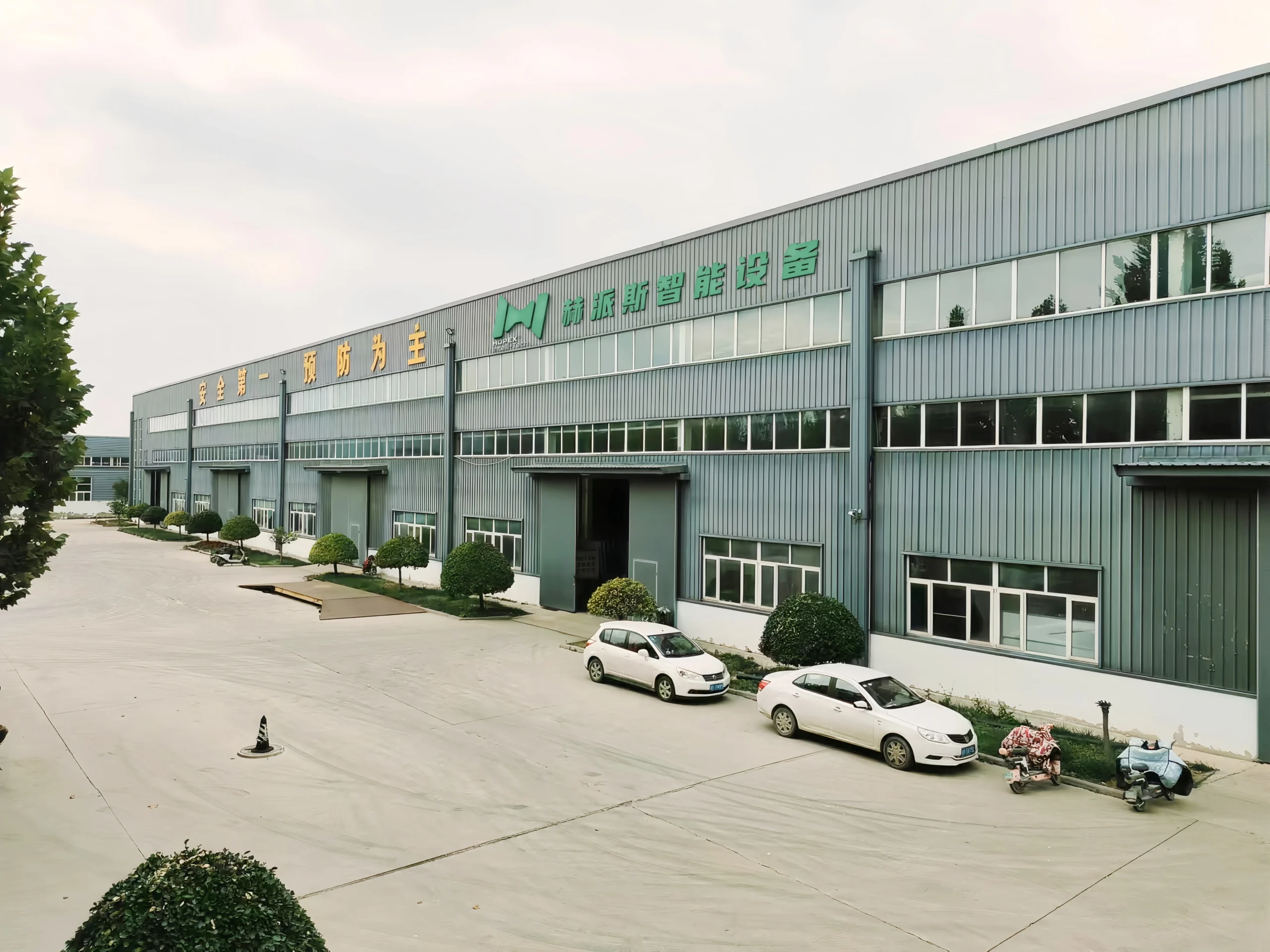
To consistently output premium-grade trays that meet strict international structural requirements, manufacturers rely on high-precision, heavy-duty industrial applications. As a premium subsidiary of the Haixing Group, Hopex (Tianjin) Intelligent Technology Co., LTD. delivers 28 years of focused manufacturing expertise in heavy-duty cold roll forming line engineering.
Below is an in-depth, step-by-step breakdown of the advanced manufacturing process that powers the world’s most efficient cable tray factories.
The Step-by-Step Galvanized Steel Cable Tray Production Process
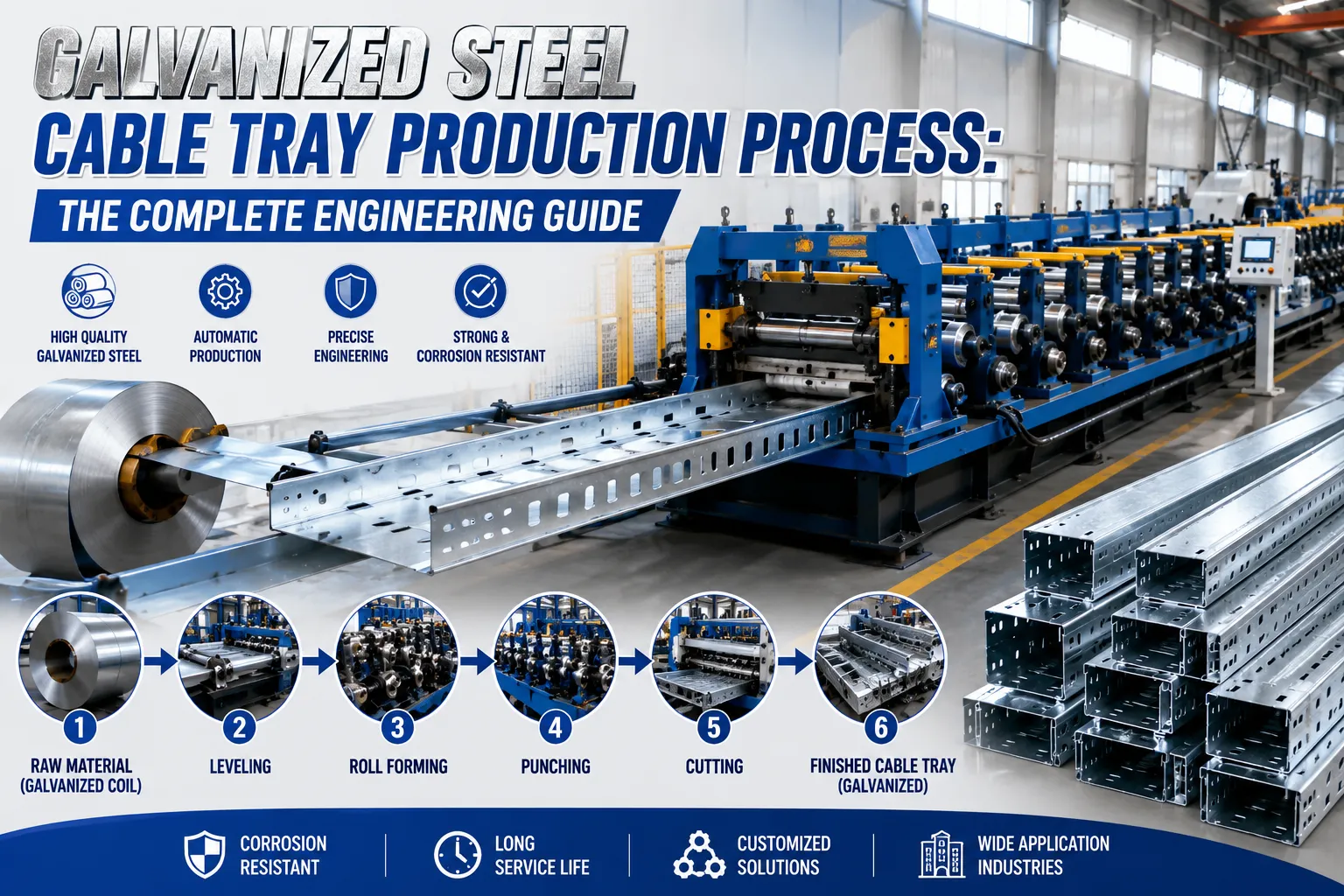
A modern, high-speed cable tray machine turns raw, heavy galvanized steel coils into perfectly punched, formed, and finished cable management profiles through a continuous, fully automated workflow.
Step 1: Material Preparation & Slitting
The process begins with heavy-duty galvanized steel coils. Because master coils from steel mills come in standard wide sizes, they must first be prepared to match the specific width of the target cable tray profile.
The Technology: A high-speed steel coil slitting machine precisely shears the wide master coil into multiple narrower strips of exact dimensions. This ensures optimal material utilization and zero edge defects before the steel ever reaches the forming line.
Step 2: Uncoiling, Leveling, and Calibrating
Once the slitted coil is loaded onto the decoiler of the main production line, it enters the feeding stage. Raw steel coils naturally retain “coil set”—a persistent curvature from being tightly wound.
The Technology: The steel pass through an integrated cut to length machine acting as a high-precision leveling and calibrating unit. Multiple alternating rollers flatten the metal strip, eliminating internal material stresses. If the steel is not perfectly leveled at this stage, the finished cable trays may twist, warp, or bow during subsequent bending steps.
Step 3: High-Density Precision Punching
Galvanized steel cable trays require intricate, dense patterns of slots and holes. These perforations serve two vital purposes: providing ventilation to prevent power cables from overheating and offering mounting points for fast job-site installation.
The Technology: The leveled steel strip advances into a heavy-duty hydraulic punching press. Managed by a high-end, well-known brand PLC control system, the punching dies stamp out the exact hole configurations at high speeds with millimeter-level accuracy. The automation syncs the feeding and punching speeds perfectly to prevent any tearing or deformation around the perforated zones.
Step 4: High-Speed Cold Roll Forming
This is the heart of the production process. The flat, punched galvanized steel strip passes through a sequential series of precisely engineered forming rollers. Each pairs of rollers incrementally bends the metal, gradually shaping the flat sheet into the classic “U”, “C”, or ladder-type profile of a cable tray.
The Technology: Hopex heavy-duty cold roll forming line solutions feature robust roll-tooling and high-torque motors. The process uses localized cold working rather than heat, which preserves the structural integrity and the protective zinc coating of the galvanized steel, ensuring the final product maintains its anti-corrosive properties.
Step 5: Hydraulic Post-Cutting & Discharging
Once the formed profile reaches its exact pre-programmed length, it must be severed cleanly without deforming the shaped flanges.
The Technology: A specialized hydraulic tracking profile cut-off tool clamps down and slices the tray cleanly. The finished galvanized steel cable tray is then automatically transferred via a discharge rack to the stacking area, completely ready for packaging, shipping, and immediate field deployment.
Key Technical Factors for Maximum Production Efficiency
To scale a cable tray manufacturing business successfully, simply understanding the steps is not enough. Your equipment must execute this process with high consistency and a competitive edge. High-end configurations from Hopex optimize this process through:
Multifunctional Operation & Adaptability: Cable tray factories must produce various widths and depths. Our advanced lines feature thickness range customization and automated width adjustments via an intuitive interface, reducing profile changeover times from hours to minutes.
Long Service Life Componentry: Handling heavy galvanized steel subjects machinery to immense mechanical fatigue. We equip our production lines with medium and high configurations, including well-known brand PLCs, motors, and frequency converters to ensure steady, energy-saving performance over decades.
Intelligent Remote Control: With integrated remote control capabilities, your production managers can track performance metrics in real-time, while our engineering teams can provide instant, online after-sales support to ensure zero operational bottlenecks.
Why Choose Hopex as Your Production Partner?
Executing a flawless galvanized steel cable tray production process requires an authoritative machinery manufacturer. Backed by CE and ISO certifications, Hopex has successfully exported customized high-speed cold roll forming equipment to more than 150 countries and regions—including North America, the Middle East, Central Asia, India, Russia, and Southeast Asia.
We don’t just sell machinery; we provide comprehensive, full-lifecycle support including custom profile drawings, multilingual instruction manuals, localized operation interface languages, and dedicated on-site installation. Guided by our core tenets—Technological innovation, Customer-centricity, and Win-win cooperation—our professional technical and export teams ensure your factory operates at peak profitability.
Ready to maximize your production output? Contact Hopex today to get a customized engineering proposal and a direct factory quote for your cable tray factory. Let’s join hands and strive for mutual success!
Frequently Asked Questions (FAQ)
Q1: Does the roll forming process damage the zinc coating on galvanized steel? No. Our cold roll forming rollers are engineered with precision surface treatments and optimal radius curves specifically designed to form galvanized steel without scratching, cracking, or stripping the protective zinc layer.
Q2: Can a Hopex cable tray production line handle different thicknesses of galvanized steel? Yes. Our heavy-duty lines are engineered with flexible thickness range customization, allowing you to switch between light-duty commercial trays and thick, heavy-duty industrial cable management systems seamlessly.
Q3: How do you support international clients with machine setup? We provide complete, worry-free global deployment. This includes providing localized operation interface languages, multilingual instruction manuals, and deploying our engineering team for on-site installation, calibration, and local operator training.