In the rapidly expanding sectors of modern construction, infrastructure development, and industrial engineering, the demand for robust electrical containment systems is higher than ever. At the heart of this supply chain is the humble cable tray—an essential component for safe, organized, and reliable cable management.
For manufacturers looking to capture this booming market, traditional, labor-intensive fabrication methods are no longer viable. To stay competitive, forward-thinking businesses are upgrading to fully automated cable tray production lines.
But how exactly does a modern cable tray roll forming machine revolutionize a factory floor? Let’s explore how integrating an advanced production line dramatically boosts manufacturing efficiency, slash operational costs, and skyrockets your overall productivity.
1. Seamless End-to-End Automation
The most significant bottleneck in traditional sheet metal fabrication is the fragmented workflow. Moving sheets manually from a shearing machine to a punching press, and then to a press brake, introduces massive downtime and human error.
An integrated cable tray production line solves this by unifying the entire manufacturing process into a single, continuous workflow:
By transitioning to a fully automated system, material handles itself from raw steel coil to a finished, retail-ready cable tray in seconds. This hands-free operation ensures that your output is dictated by machine cycle times rather than operator fatigue.
2. Unmatched Precision with Servo-Driven Punching
Cable trays require complex and precise ventilation patterns, slot alignments, and coupling holes to ensure easy on-site installation. Manual layout and punching are incredibly slow and prone to dimensional errors.
Modern production lines feature heavy-duty servo-driven hydraulic punching systems controlled by a central PLC (Programmable Logic Controller).
Flawless Consistency: Every single slot and connector hole is punched with millimeter-level accuracy.
Narrower Tolerances: Consistent spacing ensures that accessories like splice plates, bends, and covers fit together perfectly on the job site.
Reduced Scrap Rate: Precision engineering eliminates the “measure twice, cut once” human error, drastically lowering material waste and saving you valuable raw material costs.
3. Incredible Production Speeds
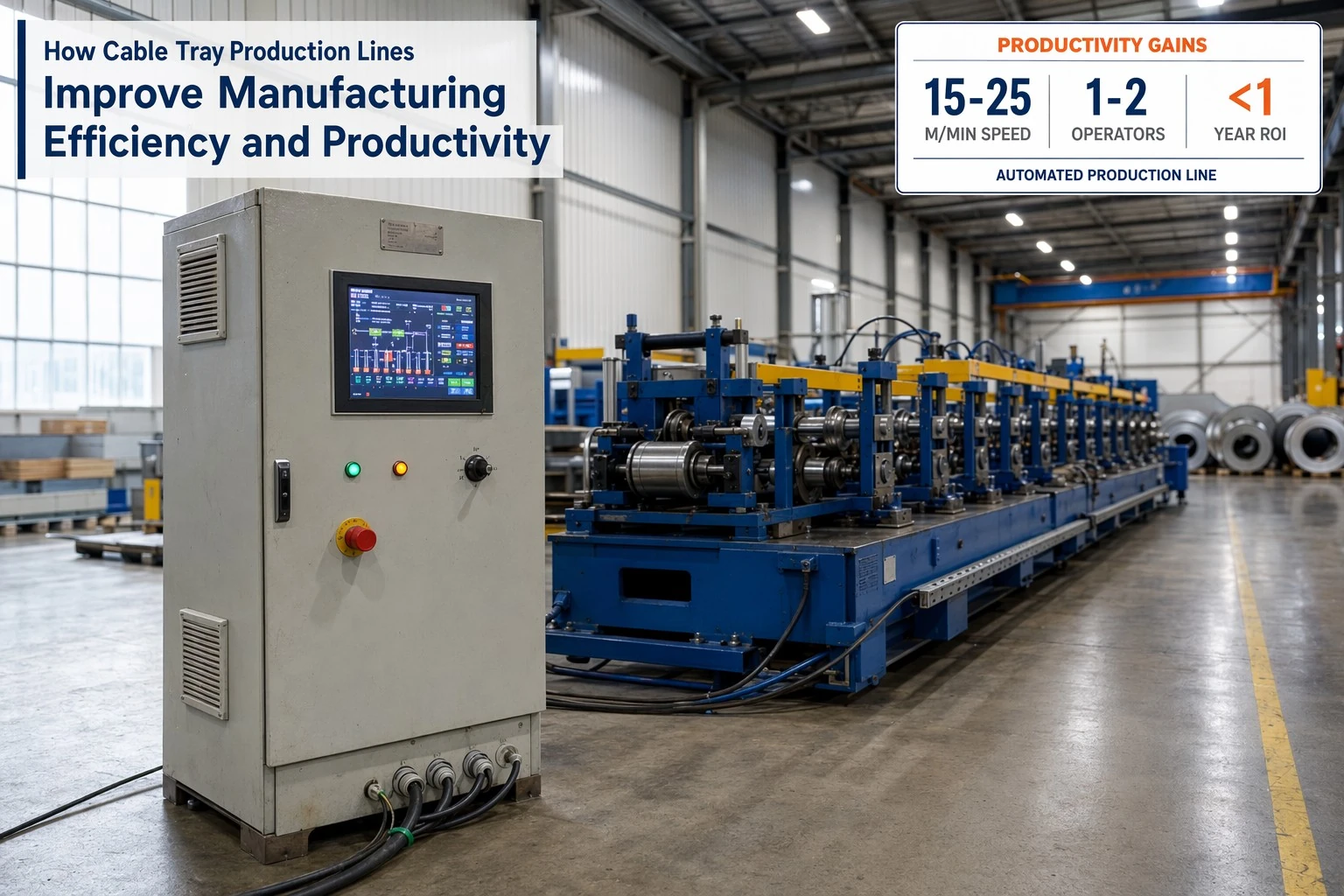
When it comes to manufacturing, speed equals profitability. While a manual press brake can only produce a handful of customized profiles per hour, a specialized cable tray roll forming machine can run continuously at speeds of 15 to 25 meters per minute.
This allows factories to scale up their daily output exponentially. Whether you are producing perforated, ladder-type, or solid-bottom cable trays, the high-speed continuous forming capability ensures you can fulfill large-scale commercial contracts on short notice without bottlenecking your delivery pipeline.
4. Unrivaled Profile Flexibility and Fast Adjustability
A common concern for manufacturers is whether one machine can handle different tray sizes. Thanks to advanced engineering, modern cable tray production lines are highly flexible.
Many high-quality roll forming systems feature motorized width and height adjustment. With the push of a button on the PLC touch screen, the rollers automatically adjust to accommodate different widths (e.g., from 100mm up to 600mm or more) and different flange heights.
| Feature | Old Fabrication Methods | Modern Cable Tray Production Line |
| Labor Requirement | High (Multiple operators needed) | Minimal (1-2 supervisors) |
| Production Speed | Slow & Fragmented | Fast & Continuous (15-25 m/min) |
| Material Waste | High (Due to manual cutting/punching) | Extremely Low (Optimized strip nesting) |
| Size Adjustments | Manual tooling changes (Hours) | Motorized automatic adjustment (Minutes) |
5. Drastically Reduced Labor Costs and Safer Operations
Relying on physical labor to lift, feed, and bend heavy steel sheets is not only expensive but also poses significant workplace safety risks.
By utilizing an automated line, you only need one or two operators to supervise the system, load raw coils, and manage the output stacker. This allows you to reallocate your workforce to other high-value tasks, significantly cutting down your per-unit labor costs while creating a much safer, low-risk working environment.
💡 The Bottom Line on Return on Investment (ROI)
Investing in a high-quality cable tray production line is not just an equipment upgrade; it’s a business transformation. By combining rapid cycle times, minimal scrap, reduced labor costs, and unmatched dimensional accuracy, most manufacturers see complete ROI within the first year of operation.
Ready to Elevate Your Production?
In the competitive market of electrical containment manufacturing, the companies that deliver high-quality products the fastest will always win the contract. Upgrading to an automated cable tray machine is your ticket to dominating this space.
Whether you specialize in galvanized steel, stainless steel, or aluminum cable trays, we design custom roll forming solutions tailored to your specific profiles and volume requirements.