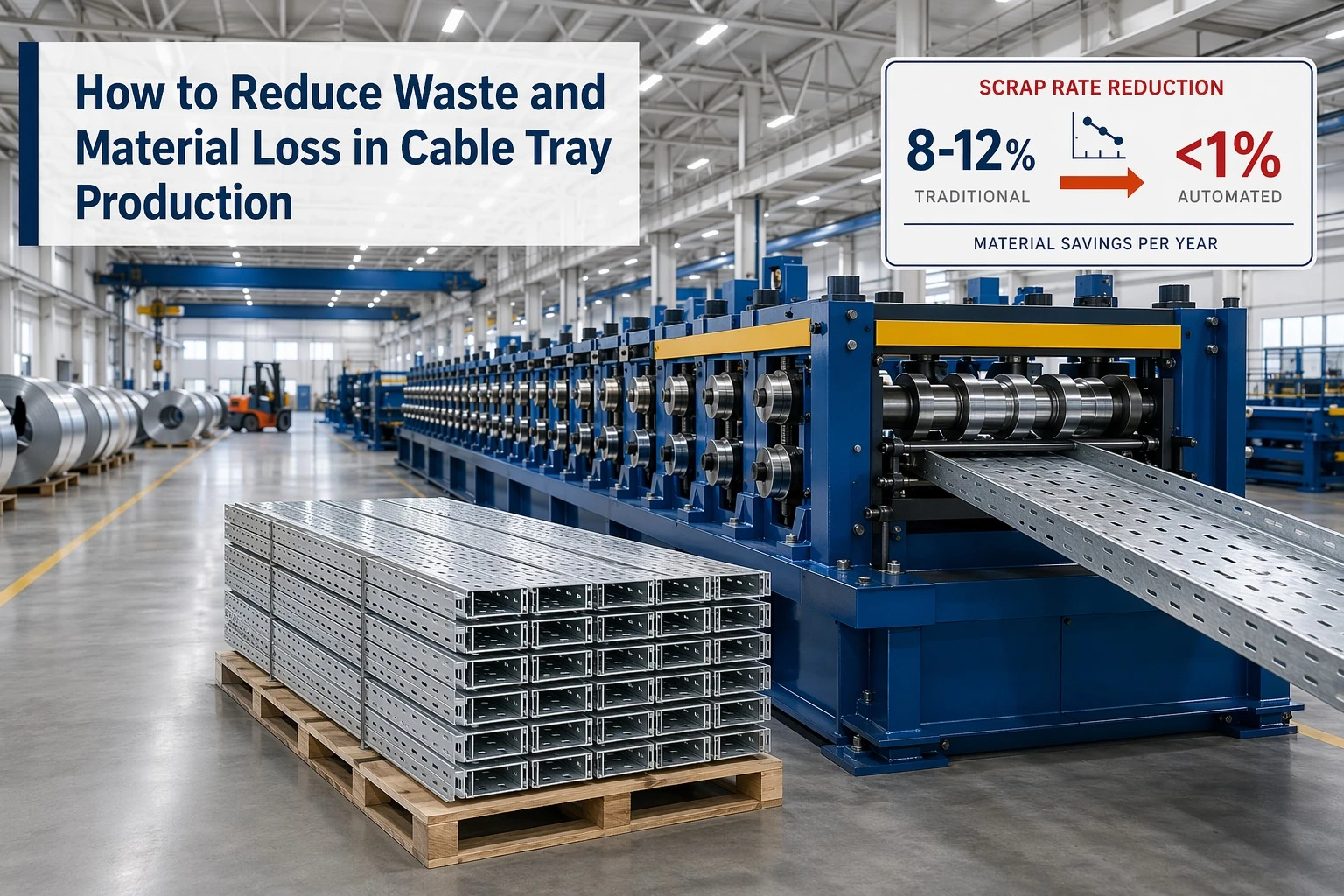
In high-volume metal manufacturing, raw material typically accounts for up to 70% of the total production cost. For manufacturers of electrical containment systems, steel is your greatest asset—and your biggest potential source of financial leakage. With fluctuating steel prices and tightening project margins, reducing material scrap is no longer just an environmental goal; it is a critical requirement for business survival.
Traditional, fragmented fabrication methods often result in scrap rates as high as 8% to 12% due to manual cutting errors, improper sheet nesting, and punch alignment mistakes. However, upgrading to an advanced, automated cable tray production line allows you to slash material loss to under 1%, directly boosting your bottom line.
This article explores the strategic engineering practices and technological features that will eliminate material waste on your shop floor and maximize your raw material yield.
1. Implement High-Precision Servo-Driven Feeding and Punching
Cable trays require complex ventilation patterns, slot configurations, and connector holes. In legacy workshop setups, operators manually align and punch sheets, which frequently leads to dimensional drift. When holes are misaligned by even a single millimeter, the entire tray length often becomes unusable scrap.
Upgrading to an automated cable tray roll forming machine integrated with a servo-driven hydraulic punching system solves this issue:
Precision Tracking: High-resolution optical encoders and servo motors feed the steel strip at exact, programmed intervals.
Closed-Loop Control: The control system constantly monitors feed length, preventing cumulative measurement errors.
Consistent Punching: Because every ventilation slot and connection hole is positioned with absolute consistency (tolerances under $pm0.5text$), material rejection rates drop to virtually zero.
2. Transition to Continuous Coil Feeding with Precision Leveling
Using pre-cut sheet metal for cable tray fabrication creates significant waste. Every individual sheet has a leading and trailing edge that cannot be fully formed, leaving behind unusable "tails" and offcuts that end up in the scrap bin.
A high-performance automated production line bypasses this issue by utilizing continuous steel coils paired with a heavy-duty leveling system:
Uncoiling: Raw steel coils are continuously fed into the system via an automated decoiler.
Leveling: A multi-roller leveling machine flattens the coiled metal, eliminating internal stresses, coil set, and edge wave.
Continuous Forming: The perfectly flat strip enters the roll forming stands as one unbroken piece.
By eliminating individual sheet boundaries, you achieve a continuous, uninterrupted flow that drastically reduces end-of-run trim waste.
3. Leverage "On-the-Fly" Cutting Systems
Standard post-cut shearing systems often require the entire production line to pause while a stationary blade slices the finished tray. This sudden stop-and-start cycle creates physical stress on the metal, which can result in bent profiles, distorted tray ends, and finished pieces that fail quality inspections.
High-efficiency production lines solve this bottleneck through flying hydraulic shear technology:
Dynamic Cutting: The shear assembly is mounted on a synchronized sliding carriage that tracks the speed of the moving profile.
Zero Deformation: The blade cuts the tray while in motion, ensuring a clean, square, and burr-free edge.
Elimination of Rework: Perfect cuts eliminate the need for post-production grinding or manual trimming, saving both material and labor costs.
4. Maximize Flexibility with Multi-Size Tooling Adjustability
A significant source of material waste occurs during trial-and-error setups when changing production sizes. In older setups, operators spent hours manually swapping out rollers, often running several test pieces of valuable steel to check if the alignment was correct before beginning a production run.
Modern automated machinery features motorized, PLC-controlled width adjustment:
Pre-Programmed Dimensions: Digital profiles are stored directly in the system's database.
Automated Positioning: Rollers automatically slide to the exact millimeter on high-precision linear guides.
Instant Verification: Because the machine positions itself with absolute accuracy, you get a perfect, ready-to-sell cable tray on the very first run—completely eliminating test-run scrap.
Material Yield: Automated Production vs. Manual Fabrication
| Operational Factor | Manual Sheet Fabrication | Automated Coil Production Line |
| Average Scrap Rate | 8% – 12% (high offcut waste) | <1% (optimized continuous nesting) |
| Test-Run Material Loss | High (several trial sheets per setup change) | Zero (first-time-right digital adjustment) |
| Material Input | Expensive pre-cut sheet metal | Cost-effective bulk steel coils |
| Edge Finish Quality | Variable (requires manual grinding/deburring) | Perfect (clean, burr-free flying cut) |
💡 The Long-Term Economic Impact
For a factory processing 5,000 tons of galvanized steel per year, reducing your scrap rate from 8% down to 1% saves approximately 350 tons of raw steel annually. At current steel market prices, these material savings alone can completely pay for a premium automated roll forming machine in less than a year.
Ready to Maximize Your Factory's Material Efficiency?
Reducing material waste is the fastest way to increase your profitability without raising your prices. By upgrading to an automated cable tray production line, you can secure higher profit margins, lower your cost-per-piece, and deliver consistently flawless products to your clients.
We design and manufacture heavy-duty, highly efficient roll forming systems engineered to optimize material yield and maximize your return on investment.