
Deep Cable Tray Machine 100-500mm
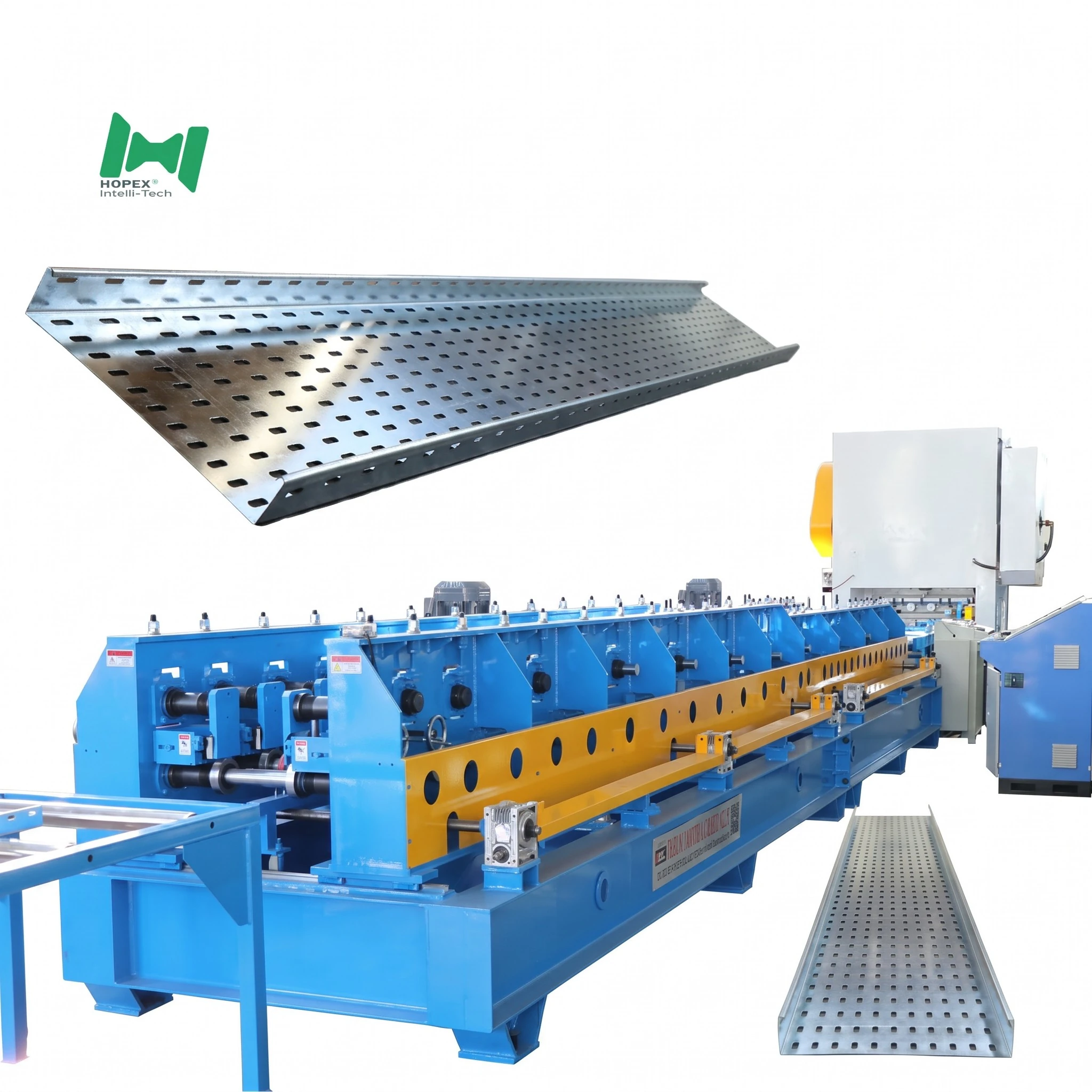
Structural-engineering-rated deep cable tray machine for 75–150 mm side-wall profiles in 100–500 mm base width. Produces deep-profile perforated trays that meet IEC 61537 high fill-ratio requirements and span up to 4 m between hangers at rated cable load. Combines a 6-tonne decoiler, 11-roller servo leveler, 200-tonne Shandong press with combination die, and 22-pass mill on a φ70 mm shaft driven by three 5.5 kW distributed motors. Runs 1.5–2.0 mm Q235B, galvanized or stainless steel (304/316/316L). 6-metre workpiece. 60 kW installed, 380 V / 50 Hz.
Project specifications are calling for deeper cable trays. The reason is structural, not cosmetic — and this deep cable tray machine is built to meet it. This 100-500mm line forms trays with side heights from 75 to 150 mm in 1.5–2.0 mm Q235B, galvanized or stainless steel, punched by a 200-tonne Shandong mechanical press with a combination die and roll-formed through a 22-pass mill on a φ70 mm shaft driven by three 5.5 kW distributed motors. Moreover, six standard size combinations cover the deep-profile cable tray envelope from equipment-room branch runs up to large-bore MV trunk runs.
The line holds ±1.5 mm on length and width, runs at 6–10 m/min (governed by hole density), and produces workpieces up to 6000 mm long. In short, it is the equipment specification for fabricators supplying deep-profile cable trays to utility, data-centre, industrial and infrastructure projects where standard 50–100 mm trays do not meet the engineering brief.
What Deep Profile Actually Buys on the Jobsite
The difference between a 75 mm and a 150 mm side wall is not simply more cable space. Furthermore, three structural and regulatory consequences change what a specifier can do with the tray run:
1. Higher Second Moment of Area
A deeper side wall dramatically increases the tray’s second moment of area (I) — the geometric property that governs how much a beam deflects under load. Specifically, doubling the wall height from 75 to 150 mm increases I by approximately eight times, not two. Consequently, a 150 mm deep tray spans twice the distance a 75 mm tray can before deflecting beyond its allowable limit — reducing the number of support hangers in the run.
2. Higher Cable Fill Capacity at Standard Current Rating
IEC 61537 and NEMA VE 1 both define maximum cable fill ratios. Furthermore, exceeding the fill ratio requires derating the current capacity of every cable in the tray. Therefore, deeper trays carry more cables at full rated current — reducing the number of parallel tray runs a large cable installation needs.
3. Code-Driven Minimum Wall Heights
Several installation codes — including IEC 60364-5-52 for fixed installations and site-specific requirements from nuclear, offshore and data-centre clients — specify minimum tray wall heights for cable mass containment and thermal management. As a result, 75 mm or 100 mm trays are simply not permitted in certain project zones, regardless of fill ratio.
Span vs Wall Height — The Deflection Relationship
For tray buyers specifying hanger spacing, the wall height is the primary variable. Notably, the table below shows why a 150 mm wall enables longer spans from the same steel weight per metre:
Values are indicative for 1.5 mm galvanized steel at the stated cable load. Actual design load must be confirmed per project.
As a result, specifying 150 mm deep trays on a long cable run often reduces hanger count and installation labour more than the additional tray material adds to the project schedule. Furthermore, fewer hangers means fewer ceiling penetrations — a significant consideration in cleanroom and rated-ceiling environments.
Deep Cable Tray Machine at a Glance
Cable Fill Ratio — The Engineering Case for 150mm
IEC 61537 clause 8 defines the usable fill area of a cable tray as a function of its internal cross-section, then caps cable fill at 50–60 % of that area (depending on cable type and tray ventilation). Furthermore, as cable bundles increase in a tray, the mutual heating effect increases — reducing the current rating of every cable present.
A 150 mm deep tray compared to a 75 mm deep tray of the same base width provides roughly double the usable cross-section. As a result:
- More cables fit within the fill ratio limit — no parallel tray run needed
- Bundle derating is lower — cables carry closer to their individual ratings
- Future capacity expansion fits in the same tray run — no structural rework
Additionally, ventilated (perforated) trays allow a higher fill ratio than solid-bottom trays under IEC 61537, because convection removes heat from the cable bundle. Consequently, this deep cable tray machine — which produces perforated trays via the 200T combination die — delivers both the depth and the ventilation that maximum fill capacity requires.
Six Standard Sizes This Deep Cable Tray Machine Covers
The 100–500 mm width range and 75–150 mm side-height range yields six primary deep-profile tray configurations off a single setup:
Furthermore, the two 1.5 kW automatic open/close motors handle width preset changes from the HMI — a stored recipe change between 100 and 500 mm, not a mechanical shim job.
Why φ70 mm Shaft for a 150mm Deep Profile
Most cable tray forming mills use φ50 or φ65 mm shafts. However, forming a 150 mm side wall requires bending 1.5–2.0 mm strip through a much larger total forming angle than a 50 or 100 mm wall. Consequently, forming load at the deepest passes is significantly higher.
This deep cable tray machine runs a φ70 mm 45# steel shaft — the larger diameter reduces shaft deflection under that load. Furthermore, the three-motor distributed drive means peak torque at each section of the mill stays within the chain rating — no chain fatigue on the deep-profile passes that do most of the forming work.
Additionally, the Cr12 rollers on the deep-profile sections are dimensioned for 2.0 mm strip at 150 mm wall — the hardness and profile accuracy hold through millions of deep-bend cycles.
Full Line Walk-Through
The line reads left to right in six stations:
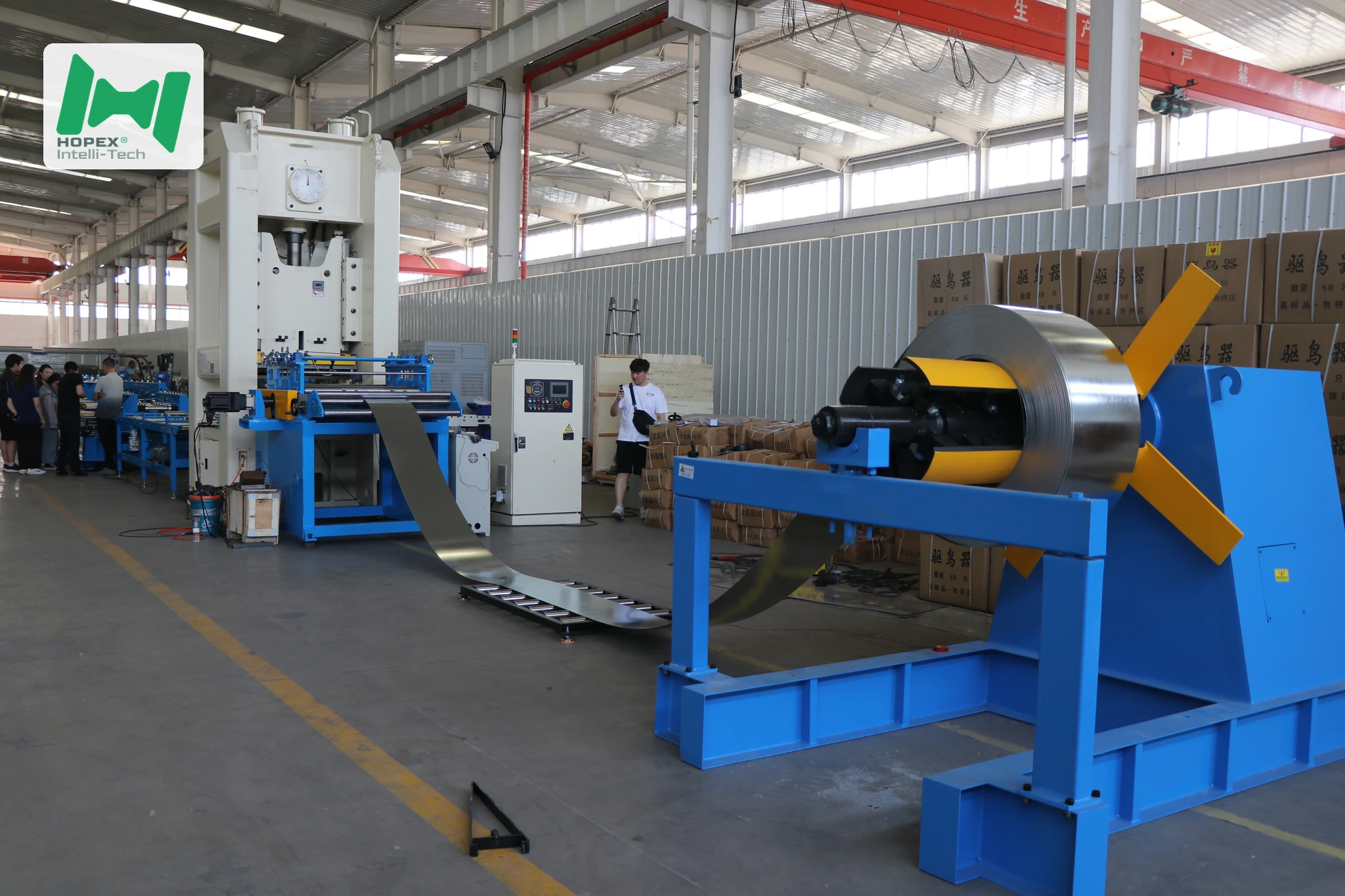
6-tonne decoiler → 11-roller leveler + servo feeder → 200T Shandong press (combination die) → 3m conveyor → 22-pass forming mill → 3m run-out
1. Decoiler — 6-Tonne Hydraulic
Hydraulic expanding mandrel with electric drive. Inner diameter opens from φ460 to φ520 mm; outer diameter accepts up to φ1600 mm. Because payoff is powered, heavy 2.0 mm strip pays out under controlled tension without slippage.
2. Leveling + Servo Feeding — 11 Rollers
The 11-roller leveler (3 upper, 4 lower, 2 clamp pairs) with φ100 mm rollers and 4 kW motor flattens the strip. Furthermore, servo pitch feeding advances the strip to the press at die-stroke position — critical for deep-profile trays where hole-to-edge registration matters as much as hole-to-hole spacing.
3. 200T Shandong Press — Combination Die
The Shandong 200-tonne mechanical press closes the combination die in one stroke: punching the full ventilation hole pattern and shearing the blank simultaneously. Consequently, hole registration and cut length are die-set, not accumulated by repeat feeder cycles. Additionally, 200 T is the correct tonnage class for 2.0 mm stainless punching without edge micro-cracks.
4. Conveyor — 3-Metre Powered
A 3-metre roller conveyor (1.5 kW main, 0.37 kW electric open/close) carries the pre-punched blank to the mill.
5. Roll Forming Mill — 22 Passes on φ70 mm Shaft
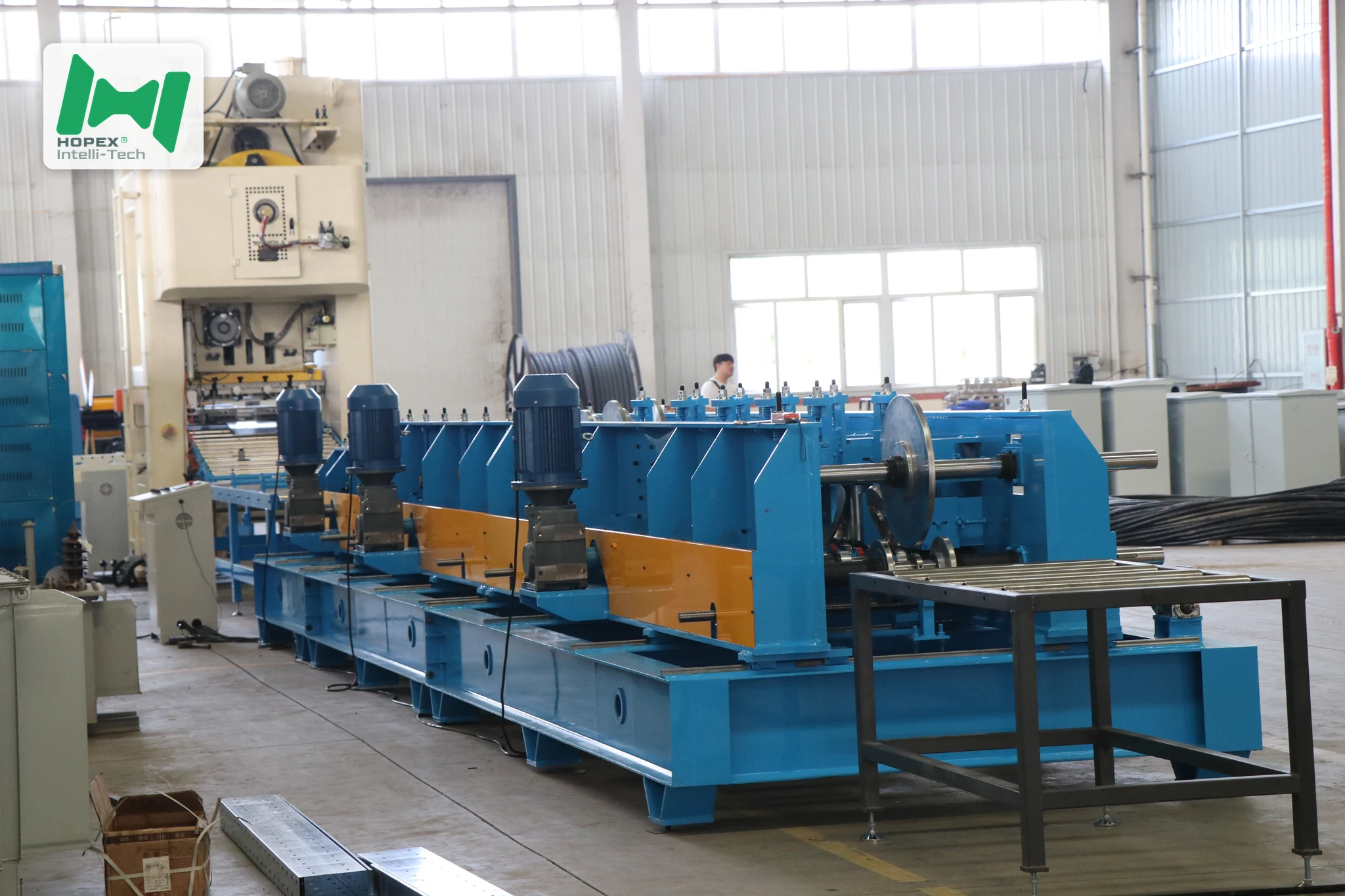
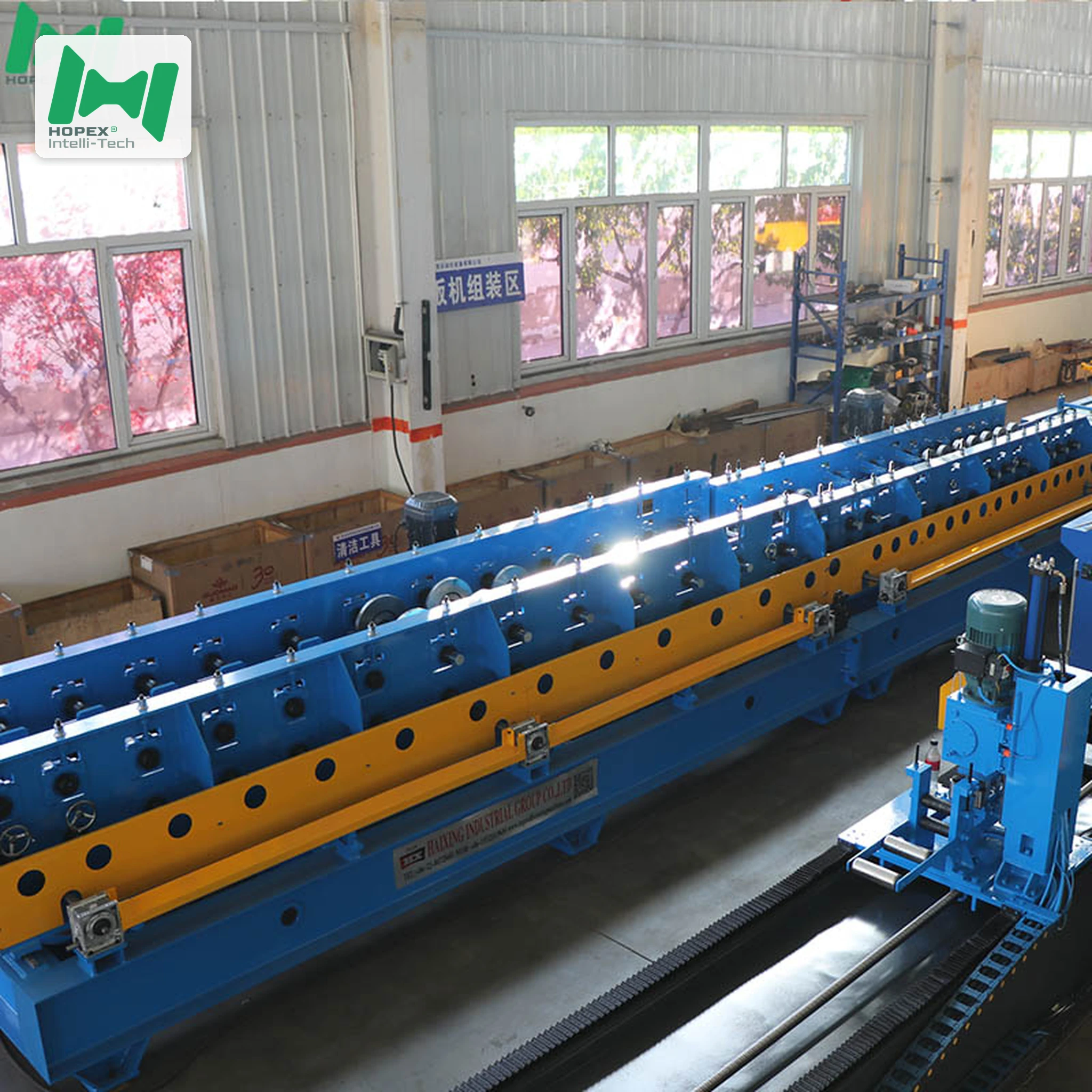
Twenty-two passes on the φ70 mm through-shaft progressively raise the walls to 75, 100 or 150 mm and finish the profile. Rollers are Cr12 tool steel. Drive is distributed across three 5.5 kW main motors and two 1.5 kW open/close motors.
6. Run-Out Platform
A 3-metre passive idler run-out discharges finished deep-profile trays for bundling or crane-lift.
Sourced Component Brands
Named parts. Therefore, spares for this deep cable tray machine are locally sourceable worldwide.
Note: brands listed cover main equipment. Auxiliary parts may vary by production batch; substitutions are disclosed at order confirmation.
Where the Deep Cable Tray Machine Earns Its Keep
Because it produces 75–150 mm deep profiles in both carbon and stainless steel at 2.0 mm gauge, this line suits fabricators serving engineered cable-support projects:
Common Questions
Why specify a deep cable tray instead of adding a second tray run?
A 150 mm deep tray carries more cables within IEC 61537 fill ratio than a 100 mm tray — often enough to eliminate one parallel tray run entirely. Furthermore, fewer tray runs mean fewer hangers, fewer ceiling penetrations and less cable-pulling labour. Consequently, the structural benefit of depth often outweighs the slightly higher material outlay at the project level.
What side heights can this deep cable tray machine produce?
75 mm, 100 mm and 150 mm — all three are production standard on this line. Additionally, the 1.5 kW × 2 automatic open/close motors handle height preset changes from the HMI as part of the width recipe.
What is the maximum workpiece length?
6000 mm (6 metres). Consequently, one deep-profile tray can span a full server row or a full chemical plant bay without a field splice — reducing joint maintenance points above live cable runs.
What steel grades does it handle?
Q235B cold-rolled, galvanized, and stainless steel (304, 316, 316L) from 1.5 to 2.0 mm thick. Additionally, the 200T Shandong press handles stainless punching at 2.0 mm without edge micro-cracks because the combination die delivers full tonnage in one clean stroke.
Why three 5.5 kW main motors for a 22-pass mill?
Forming a 150 mm wall at 2.0 mm gauge is among the heaviest forming loads in commercial cable tray production. Furthermore, distributing that load across three motors means each motor works within its rated capacity — no thermal derating on the deep-profile passes that do most of the work.
What is the total footprint and power draw?
35 m long × 1.5 m wide × 1.6 m high, drawing approximately 60 kW installed on 380 V / 50 Hz / 3-phase. The narrow 1.5 m width means this deep cable tray machine fits along a factory wall without requiring a dedicated bay.
Bottom Line
If your production plan calls for deep-profile perforated cable trays at 75–150 mm side height, in 1.5–2.0 mm Q235B, galvanized or stainless steel, this deep cable tray machine is the equipment for it. It combines a 6-tonne decoiler, an 11-roller servo leveler, a 200-tonne Shandong press with combination die, and a 22-pass forming mill on a φ70 mm shaft driven by three 5.5 kW distributed motors — all inside a 35 × 1.5 × 1.6 m footprint drawing approximately 60 kW installed.
For die drawings, deep-profile roller documentation, or IEC 61537 compliance data, contact our project team with your target sizes, side height, hole layout, steel grade and monthly output. Then we configure the die, deep-profile rollers and mill to your production plan. an.