
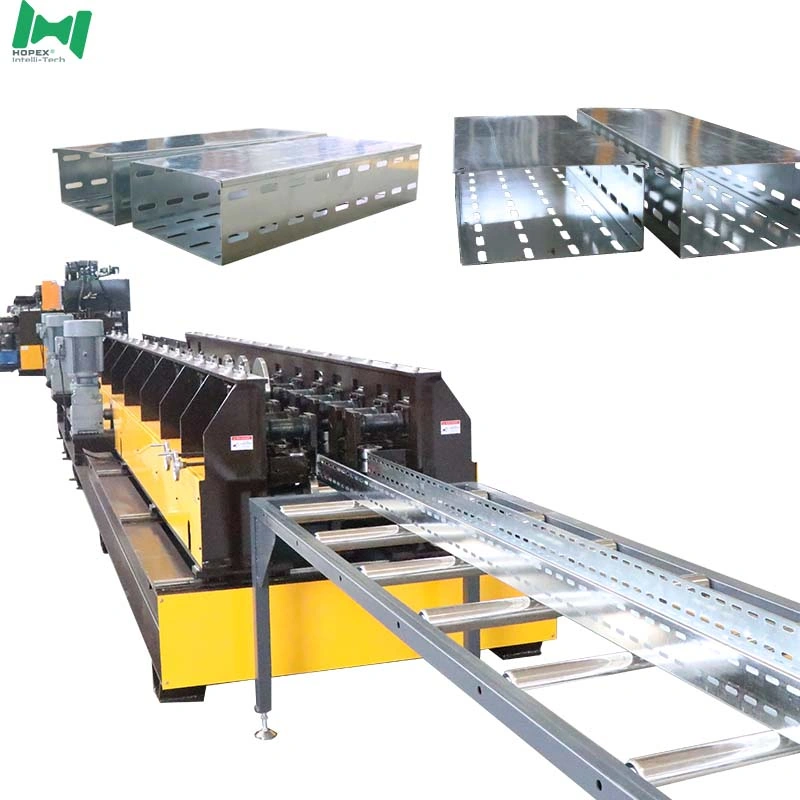
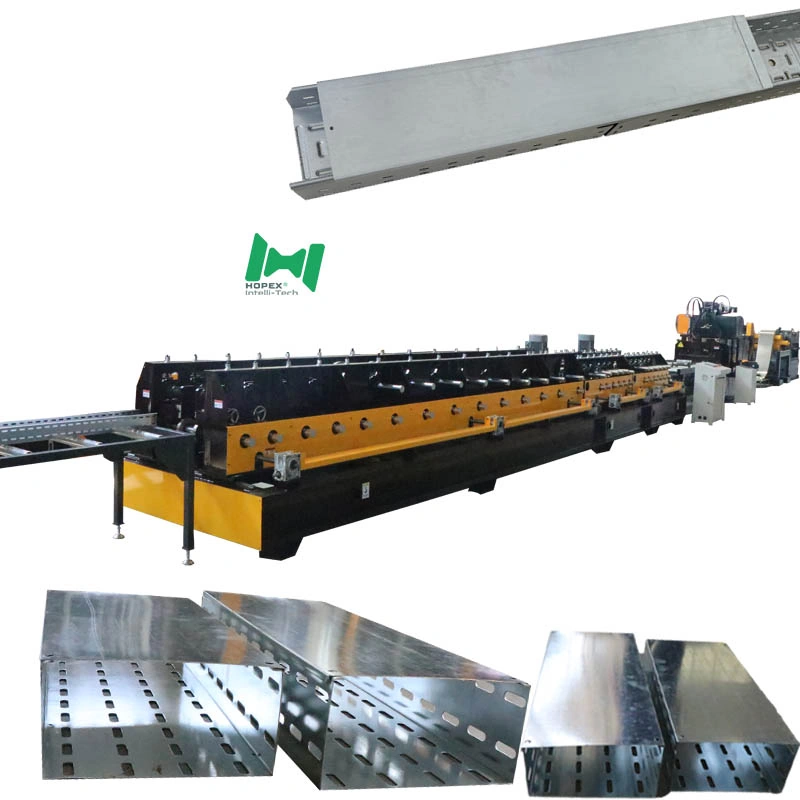
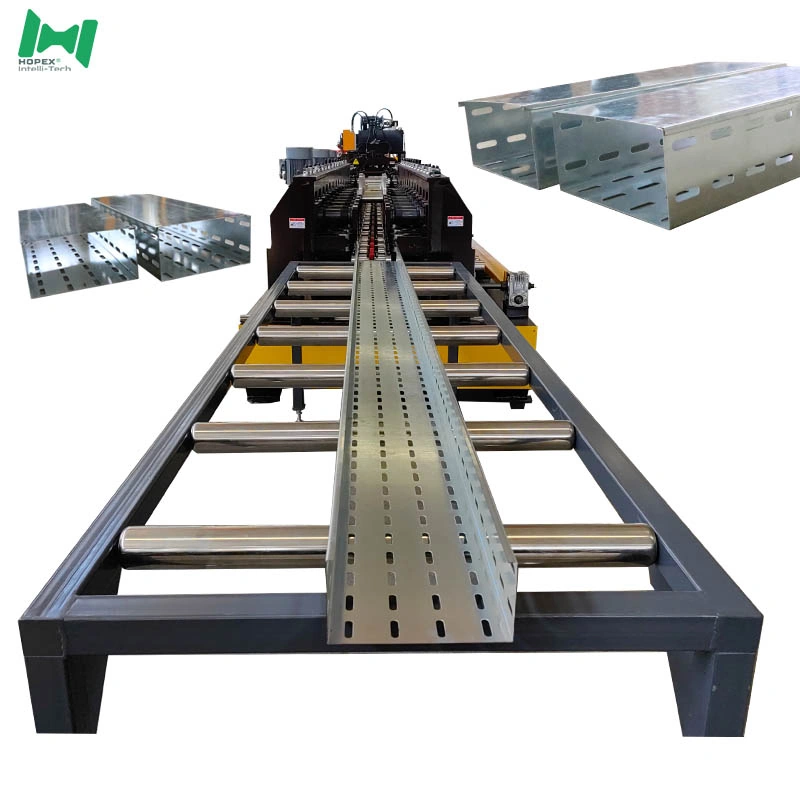
Integrated Cable Tray Roll Forming Machine 50-300mm
Integrated cable tray roll forming machine producing 50–300 mm × 50–100 mm trays across nine standard sizes at 15–20 m/min — nearly double the pace of typical inline-punch lines. Handles 0.3–1.5 mm Q235 or galvanized strip up to 6000 mm long. Combines 8-roller leveling, two-station hydraulic punching, hydraulic shearing and 22-pass forming with side + bottom reinforcing ribs, on a φ50 mm shaft, backed by an oversized 11 kW / 450 L hydraulic station.
Need a cable tray roll forming machine that keeps up with a real production schedule? This 50-300mm integrated line runs at 15–20 metres per minute — nearly double the pace of a typical inline-punch tray line. Moreover, it puts leveling, punching, shearing and forming into one continuous flow, so one operator loads a coil and finished trays roll off the far end without a manual step in between.
This cable tray roll forming machine is engineered for thin-gauge, high-volume production. Specifically, it handles strip from 0.3 mm at the low end — thin enough for lightweight indoor trays where every gram of steel counts — up to a full 1.5 mm for standard commercial work. In short, it is built for factories where uptime and speed matter as much as size flexibility.
What Integration Actually Means Here
The phrase gets thrown around; here it means something specific. Notably, four operations that normally live on separate stations are integrated into a single continuous flow:
- 8-roller precision leveling with lift-linkage
- Two-station hydraulic hole punching
- Hydraulic shearing in the same frame as the punch
- 22-pass roll forming with a dedicated small-edge station
As a result, the strip enters flat, gets its full hole pattern, gets sheared to length, and exits the mill as a finished tray — all inside a single 35 m footprint. Consequently, there is no operator hand-off between stations and no timing drift between punched holes and cut length.
Why 15-20 m/min Changes the Business Case
Most inline-punch tray lines run at 5–12 m/min. However, this cable tray roll forming machine pushes that to 15–20 m/min on the same 0.3–1.5 mm gauge band. Furthermore, three engineering choices make the speed real, not marketed:
1. Two-Station Hydraulic Punching
Single-station punching forces the line to wait between strokes. In contrast, the two-station punch head lets the second station work while the first repositions — so the strip keeps moving instead of stopping every stroke.
2. Independent Hydraulic Station — 11 kW, 450 L Tank
Fast punching needs oil pressure the moment the stroke calls for it. Therefore, this line runs an oversized 11 kW station with a 450 L oil tank — enough thermal capacity to hold pressure through a full shift without heat-induced pressure drop.
3. 8-Roller Leveler with Lift-Linkage
Speed is worthless if the strip enters the punch with waves. Consequently, the 8-roller leveler with lift-linkage flattens the coil before the punch sees it — no chatter, no misfeeds, no scrap at 20 m/min.
Integrated Cable Tray Roll Forming Machine at a Glance
Finished Sizes — Nine Standard Combinations
The line’s height range (50–100 mm) plus width range (50–300 mm) gives fabricators nine standard finished sizes off a single setup:
Because the mill uses a servo open/close on the small-edge station, moving between these sizes is an HMI preset — not a mechanical shim change.
Why 0.3 mm Thickness Capability Matters
Most cable tray lines start at 0.7 or 1.0 mm because their leveler cannot handle thinner strip without waves. This cable tray roll forming machine starts at 0.3 mm — which opens three project categories others cannot serve:
- Data-centre server-rack cable trays — thin, light, closely spaced above racks
- Retail and hospitality ceiling runs — where weight per metre matters for suspension
- Prefab modular building trays — factory-assembled panels where every kilogram counts
The 8-roller leveler with lift-linkage is the piece that unlocks 0.3 mm — a shorter leveler simply cannot flatten thin strip enough to feed the punch cleanly.
Line Walk-Through — Eight Stations
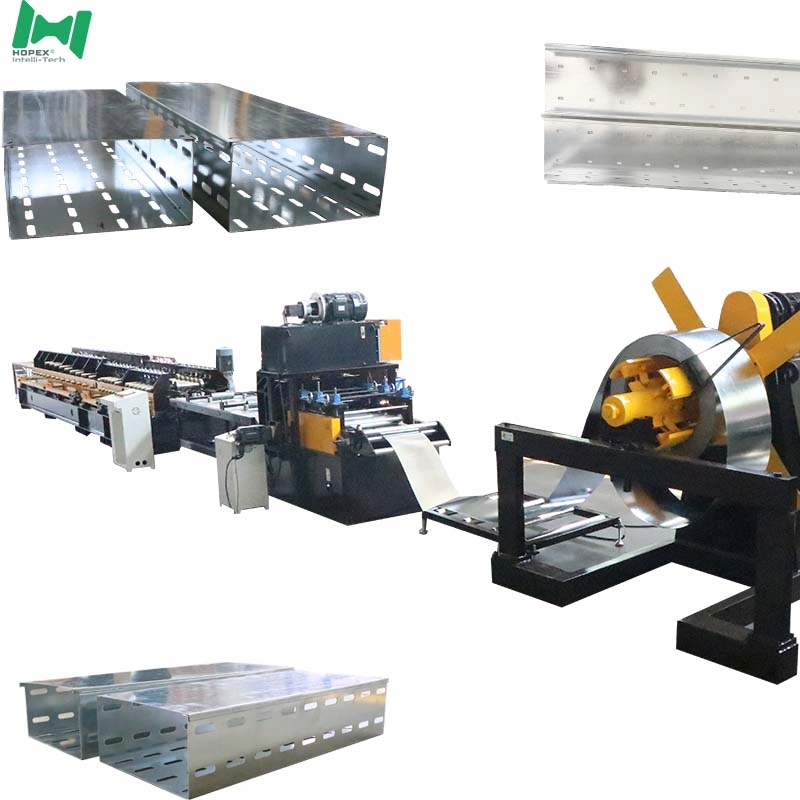
The line reads left to right in eight defined stations:
Powered decoiler → 8-roller leveler → Two-station punch + hydraulic shear → 6m conveyor → Small-edge forming → Main mill (22 passes) → Run-out → 11 kW hydraulic station
1. Powered Decoiler (6-Ton)
Hydraulic expanding mandrel with electric drive. Inner diameter opens from φ460 to φ520 mm; outer diameter accepts up to φ1500 mm. Because payoff is powered, thin 0.3 mm strip pays out under controlled tension — no snags, no coil breaks.
2. Leveling — 8 Rollers with Lift-Linkage
The 8-roller leveler with lift-linkage flattens the strip. Additionally, the lift mechanism lets the operator lift and re-thread the strip in seconds during coil changes — a small time-saver that adds up across a shift.
3. Two-Station Punching + Hydraulic Shearing
The two-station punch head carries a die set on each station. Furthermore, the hydraulic shear shares the same frame — one hydraulic circuit, one control loop, zero drift between hole pitch and cut length.
4. Conveyor — 6-Metre Powered Table
A 6-metre powered roller table with electric open/close carries the sheared blank from the punch to the mill. Notably, the extra length (versus a 3-metre standard table) is what enables the up-to-6000 mm workpiece capability — long trays for factory ceilings and warehouse runs.
5. Small-Edge Roll Forming
The small edge (7–12 mm) is where the tray’s rim lives. The station includes:
- Small-edge levelling — removes lift caused by punch stress
- Guiding — keeps the strip on centreline
- Scale-plate pressure adjustment — repeatable pressure per size
- Spring-adjusted pressure — fine-tune per steel grade
- Side reinforcing rib forming — stiffens the wall
Main motor: 5.5 kW. Open/close motor: 1.5 kW.
6. Main Roll Forming Mill — 22 Passes
Twenty-two forming passes on a φ50 mm shaft progressively raise the walls and finish the profile. Both side reinforcing ribs and bottom reinforcing ribs are formed in this section, so the tray leaves the mill structurally stiff even at 0.3 mm gauge. Main motor: 5.5 kW; open/close: 1.5 kW.
7. Run-Out Platform
A 3-metre passive idler run-out carries finished trays off the mill for pick-up or stacking.
8. Hydraulic Station — 11 kW / 450 L / 3-Station Valves
An independent 11 kW station feeds the punch, shear and all servo actuators. Specifically, it carries three 5.5 kW valve banks at 220 V, multiple solenoid valves, active cooling, and a 450 L oil tank for full-shift thermal stability.
Where This Integrated Cable Tray Roll Forming Machine Earns Its Keep
Speed and thin-gauge capability together define this cable tray roll forming machine’s buyer profile:
Component Brands
Sourced parts are named. Consequently, spares are locally sourceable worldwide.
Note: brands listed cover main equipment. Auxiliary parts may vary by production batch; substitutions are disclosed at order confirmation.
How This Cable Tray Roll Forming Machine Compares
If you are choosing between this line and a standard-speed 50-300mm tray line, here is the practical split:
Common Questions
Is this really an integrated cable tray roll forming machine?
Yes. Leveling, punching, shearing and forming are integrated into a single continuous line. Furthermore, the punch and shear share one hydraulic frame, so registration between hole pitch and cut length holds without operator intervention.
How is 15-20 m/min possible with inline punching?
Two engineering choices make it work: the two-station punch head (one station repositions while the other strokes) and the oversized 11 kW / 450 L hydraulic station (holds pressure across full-shift running). As a result, the punch never becomes the speed bottleneck.
Can I really form 0.3 mm strip?
Yes. The 8-roller leveler with lift-linkage is dimensioned for thin strip. However, roll pressure and forming speed are adjusted at commissioning per gauge — the operator selects a preset on the HMI.
What is the longest tray this line can make?
6000 mm (6 metres). Consequently, one tray can span a full warehouse bay without a splice — useful for factory ceilings, long conduits and prefab building panels.
How many finished sizes without a mechanical change?
Nine standard sizes between 50 × 50 mm and 300 × 100 mm. The servo open/close on the small-edge station handles width changes as an HMI preset.
What steel does the line handle?
Q235 cold-rolled and galvanized strip from 0.3 to 1.5 mm thick. The strip width band of 150–550 mm covers the full base-width range from 50 to 300 mm.
Why hydraulic shear instead of a press?
Hydraulic shearing shares the same oil circuit as the two-station punch. Therefore, it stays perfectly registered to the punch cycle without a mechanical link. Additionally, hydraulic shearing produces a clean cut edge on thin gauge where press shear would tear.
What are the reinforcing ribs on the tray?
The mill forms both side reinforcing ribs (on the walls) and bottom reinforcing ribs (on the tray floor). Consequently, even a 0.3 mm tray leaves the mill structurally stiff enough for standard installation spans.
What’s the total footprint and power draw?
35 m long × 1.8 m wide × 2.2 m high, drawing approximately 35 kW installed on 380 V / 50 Hz / 3-phase. Additionally, the dedicated hydraulic station is 11 kW with a 450 L oil tank.
Bottom Line
If your production plan calls for high-volume, thin-gauge, long-piece cable trays across nine standard sizes, this integrated 50-300mm cable tray roll forming machine is built for it. In other words, one cable tray roll forming machine replaces what used to need a separate leveler, punch, shear and mill. It combines a 6-ton powered decoiler, an 8-roller leveler with lift-linkage, a two-station hydraulic punch with integrated shear, a dedicated small-edge forming station, and a 22-pass main mill on a φ50 mm shaft — all inside a 35 × 1.8 × 2.2 m footprint drawing roughly 35 kW, with an oversized 11 kW / 450 L hydraulic station to hold pressure at 20 m/min.
For die drawings, thin-gauge sample runs, or a walk-through of the nine-size changeover on the HMI, contact our engineering team with your target sizes, hole pattern, steel grade and monthly output. Then we configure the die, small-edge rollers and mill to your production plan.