
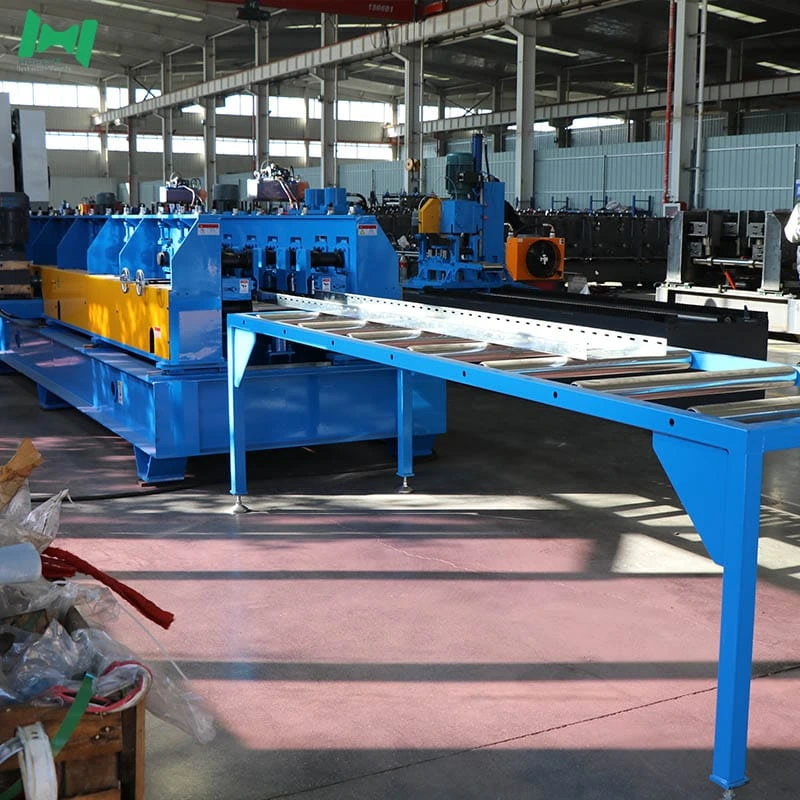
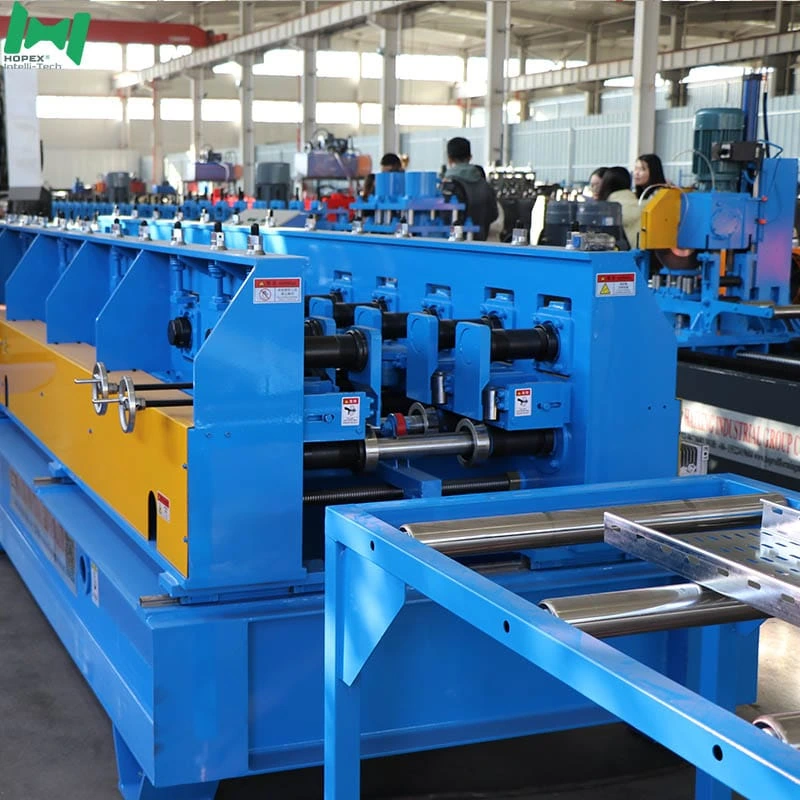
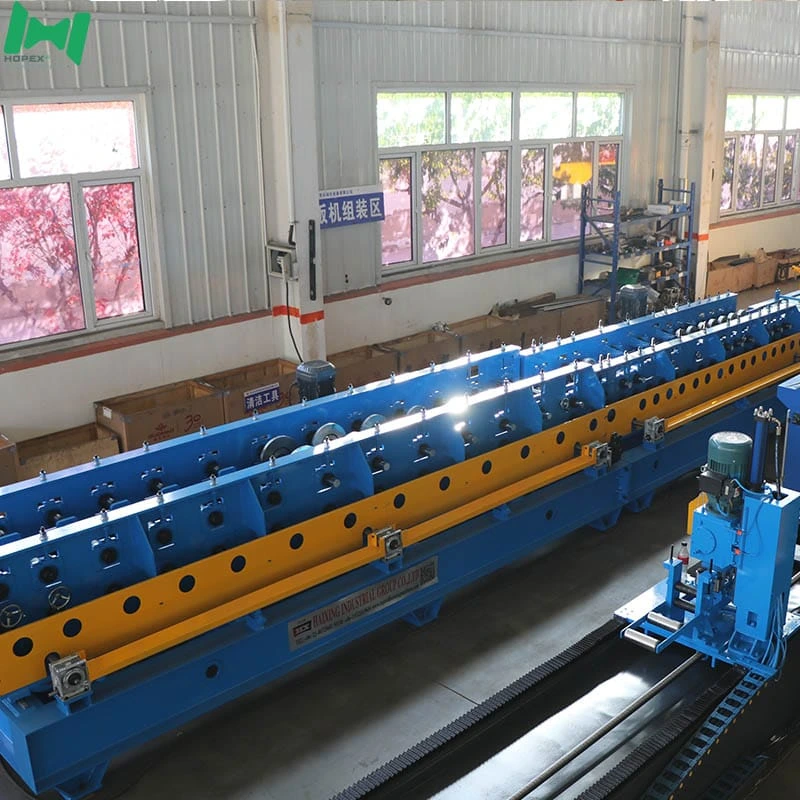
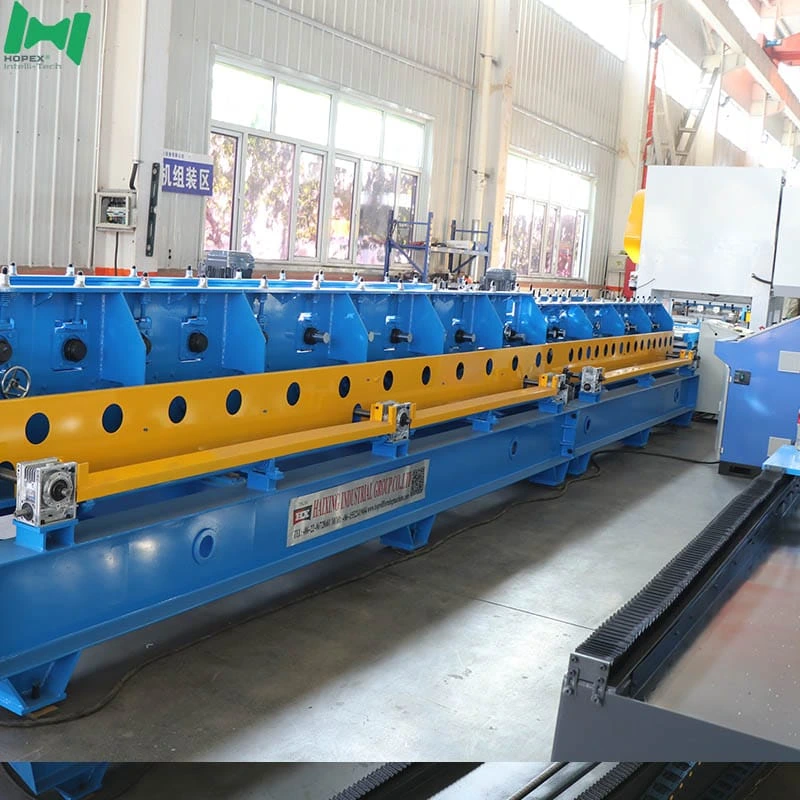
Stainless Steel Cable Tray Machine 100-500mm
Vertical-market stainless steel cable tray machine for 304, 316 and 316L deep-profile cable trays — 100–500 mm base × 75–150 mm side, in 1.5–2.0 mm gauge. Built for food and beverage processing (HACCP washdown), pharmaceutical GMP cleanrooms, marine and offshore (IEC 61892), and chemical / petrochem plants. Combines a 6-tonne decoiler, 11-roller servo leveler, 200-tonne Shandong mechanical press with combination die, and 22-pass forming mill on a φ70 mm shaft driven by three 5.5 kW distributed motors. Runs stainless and Q235 on the same line — swap to dedicated stainless roller cassettes between batches for contamination-free output.
Need a stainless steel cable tray machine rated for the vertical industries where corrosion resistance is not optional — food processing, pharmaceutical plants, offshore platforms, chemical facilities? This 100-500mm line handles it. Moreover, the mill is engineered to roll stainless steel alongside Q235B cold-rolled and galvanized strip, in the heavy 1.5–2.0 mm gauge band that regulated industries actually specify. From 100 × 75 mm branch trays up to 500 × 150 mm deep-profile trunk trays, six standard size combinations come off a single 22-pass forming mill on a φ70 mm shaft.
The line is built around a 200-tonne Shandong mechanical press, an 11-roller servo leveler-feeder, and three 5.5 kW distributed main motors. As a result, dense multi-hole ventilation patterns and 2.0 mm stainless gauge run on the same equipment without a mechanical reconfiguration. Consequently, one line covers both the standard Q235 order book and the higher-margin stainless verticals.
Which Industries Actually Need a Stainless Steel Cable Tray Machine
Stainless cable trays sit at a significant premium per finished metre over galvanized. Consequently, they are specified only where an alternative would fail — corrosion, contamination, regulatory audit, or a combination. Notably, four vertical markets drive the demand:
1. Food and Beverage Processing
Cable trays inside food-processing halls face daily washdown with detergent, high-pressure water and sometimes caustic sanitisers. Furthermore, dust or corrosion flaking from galvanized trays into food streams is a HACCP audit finding. Therefore, cable runs above and around processing equipment are increasingly specified in 304 or 316 stainless.
2. Pharmaceutical Manufacturing
Cleanroom classes ISO 5 through ISO 8 demand surfaces that do not shed, that survive vaporized hydrogen peroxide (VHP) decontamination, and that pass regulatory audit trails on material specification. Additionally, cable trays in grade-C and grade-D cleanrooms are routinely specified in 316L stainless for exactly these reasons.
3. Marine, Offshore and Coastal
Salt-air exposure destroys galvanized coatings in years, not decades. Consequently, cable trays on offshore platforms, coastal LNG terminals, ports and ship engine rooms are specified in 316 or 316L stainless to comply with IEC 61892 (mobile and fixed offshore units) and shipbuilding classification society rules.
4. Chemical, Petrochem and Fertiliser Plants
Chlorides, ammonia, acids and mixed atmospheres reduce galvanized tray life to a fraction of a plant’s operating life. Furthermore, stainless trays in 304 or 316 are the standard specification in chlor-alkali, pulp, fertiliser and refinery cable-run projects.
Stainless Steel Cable Tray Machine at a Glance
Which Grade of Stainless — Practical Selection Guide
Stainless is not one material. Notably, three grades cover the vast majority of cable tray applications:
Furthermore, this stainless steel cable tray machine rolls all three grades in the 1.5–2.0 mm gauge band. As a result, a single line covers the full stainless order book — from a dairy plant’s 304 branch trays to an offshore platform’s 316L trunk trays.
Why the Same Machine Runs Both Stainless and Q235
Running stainless on a mill originally set up for carbon steel is not automatic. Specifically, three engineering choices on this line make it a native stainless-steel cable tray machine, not a retrofitted carbon-steel line:
1. Cr12 Tool Steel Rollers
The forming rollers are Cr12 tool steel — hard enough (HRC58-62 class) to resist adhesion pickup from stainless strip. Additionally, roller surfaces are ground to a fine finish specifically to avoid transferring iron particles into the stainless surface, which would create surface rust after installation.
2. Separate Roller Set Discipline
Best practice on any stainless run is dedicated stainless-only rollers stored separately from carbon-steel rollers. Consequently, roller cassettes on this line can be swapped between production runs, keeping stainless output cross-contamination-free.
3. Servo-Fed 200T Press with Combination Die
Punching stainless at 2.0 mm demands sustained press tonnage without hesitation. Furthermore, the Shandong 200T press with combination die delivers punch + shear in one downward stroke, so the stainless blank does not sit under repeated partial-stroke stress that would produce edge micro-cracks in 316L.
Six Deep-Profile Standard Sizes on This Stainless Steel Cable Tray Machine
The mill’s 100–500 mm width range and 75–150 mm side-height range yields six standard tray sizes:
Additionally, side heights of 75, 100 and 150 mm cover the depth range that regulated industries specify most often — deeper than the 50 mm typical of light commercial work, shallow enough to fit standard cable-management fittings.
Stainless Steel Cable Tray Machine — Full Line Walk-Through
The line reads left to right in six stations:
6-tonne decoiler → 11-roller leveler + servo feeder → 200T Shandong press (punch + shear) → 3m high-speed conveyor → 22-pass forming mill → 3m run-out
1. Decoiler — 6-Tonne Hydraulic
The coil sits on a hydraulic expanding mandrel with electric drive. Inner diameter opens from φ460 to φ520 mm; outer diameter accepts up to φ1600 mm. Additionally, coil width intake spans 200–900 mm — wide enough for full 500 mm base trays with stainless flange allowance.
2. Leveling + Servo Feeding
An 11-roller leveler (3 upper, 4 lower, plus one clamp pair at each end) with φ100 mm rollers and 4 kW motor flattens the strip. Notably, the extra rollers matter more on stainless than on carbon steel — stainless carries higher internal stress from the mill, and a short leveler cannot absorb it.
3. 200T Shandong Press — Combination Die
The Shandong 200-tonne mechanical press stamps the ventilation and connection hole pattern via a combination die that punches and cuts in one stroke. Consequently, dense multi-hole stainless trays lea leave the press pre-cut, ready for forming — with no repeated partial-stroke stress that could crack 316L edges.
4. High-Speed Conveyor — 3-Metre Powered
A 3-metre roller conveyor (1.5 kW main, 0.37 kW electric open/close) moves the sheared blank from press to mill. Because it decouples press cycle from cycle, a slower forming pass does not slow the punch.
5. Roll Forming Mill — 22 Passes on φ70 mm Shaft
Twenty-two forming passes on the φ70 mm shaft progressively raise the walls up to 150 mm and finish the profile. Rollers are Cr12 tool steel. Drive is chain-based, distributed across three 5.5 kW main motors and two 1.5 kW open/close motors.
6. Run-Out Platform
A 3-metre passive idler run-out carries finished trays for pick-up. Because it is passive, discharge is clean — critical for stainless where drive-roller marks would show in the final surface finish.
Sourced Component Brands
Named parts. Therefore, spares for this stainless steel cable tray machine are locally sourceable worldwide.
Note: brands listed cover main equipment. Auxiliary parts may vary by production batch; substitutions are disclosed at order confirmation.
Where the Stainless Steel Cable Tray Machine Earns Its Keep
Because it handles both stainless and carbon steel across a heavy 1.5–2.0 mm gauge band and 75–150 mm deep profile, this line suits fabricators supplying regulated industry categories:
Standard vs. Deep Profile — When to Choose 150 mm Side Height
A 150 mm side wall is not the right answer for every project. Notably, the practical split works like this:
Furthermore, deeper trays reduce installation labour by consolidating cables into fewer, larger runs — a 500 × 150 mm tray carries roughly twice the cable capacity of a 500 × 75 mm tray at only 50 % more raw material.
Common Questions
Which stainless grades does this machine handle?
304, 316, and 316L in the 1.5–2.0 mm gauge band. Furthermore, all three run through the same 22-pass mill without a mechanical reconfiguration — grade selection happens at raw-material stocking, not at the machine.
Can I run stainless and Q235 on the same day?
Yes, but best practice is to swap to dedicated stainless rollers for the stainless batch to avoid iron pickup on the stainless surface. Consequently, most stainless steel cable tray machine operators keep two roller cassettes and swap between production runs.
Why the 200T Shandong press instead of a hydraulic punch?
At 2.0 mm stainless with a dense hole pattern, hydraulic inline punching struggles to keep edge quality and stroke consistency. The Shandong 200T mechanical press delivers full tonnage in one crisp downward stroke via a combination die — no partial-stroke stress that would crack 316L edges.
What is the maximum tray depth this machine can form?
150 mm side height — deeper than the 50 or 100 mm typical of light commercial lines. Additionally, the φ70 mm shaft and 22-pass mill are sized for that depth in stainless as well as carbon steel.
How fast does the stainless steel cable tray machine run on stainless?
6–10 m/min, same as on carbon steel. In practice, dense hole patterns pull speed toward 6 m/min; sparse patterns run near 10 m/min. Stainless does not slow the mill — the press cycle governs speed, and the press tonnage handles stainless without derating.
What tolerance does it hold?
±1.5 mm on length and width, 90° ± 2° on corner angle. Notably, this is consistent across all three approved feedstock grades (stainless, Q235B, galvanized).
Does the line need any special ventilation for stainless work?
No exhaust hood is required for cold-forming stainless. However, keeping the stainless work area physically separated from any carbon-steel cutting or grinding is standard shop discipline — airborne iron dust settling on stainless surfaces causes surface rust after installation.
What is the total footprint and power draw?
35 m long × 1.5 m wide × 1.6 m high, drawing approximately 60 kW installed on 380 V / 50 Hz / 3-phase. The narrow 1.5 m width means the line fits along a factory wall without demanding a dedicated bay.
Bottom Line
If your production plan calls for stainless-steel cable trays for food, pharma, marine, or chemical projects — in a deep 75–150 mm profile at 1.5–2.0 mm gauge — this stainless steel cable tray machine is the equipment for it. It combines a 6-tonne decoiler, an 11-roller leveler with servo feeding, a 200-tonne Shandong mechanical press with combination die, and a 22-pass forming mill on a φ70 mm shaft driven by three 5.5 kW main motors — all inside a 35 × 1.5 × 1.6 m footprint drawing approximately 60 kW installed.
For die drawings, stainless-grade selection guidance, or a walk-through of pairing this line with dedicated stainless roller cassettes, contact our project team with your target sizes, hole pattern, stainless grade and monthly output. Then we configure the die, rollers and mill setup to your production plan. an. uction plan.