The global industrial landscape is undergoing a massive shift toward automation, driven by the explosive growth of data centers, smart grids, and large-scale infrastructure projects. In this high-stakes environment, traditional, manually operated sheet metal shops are facing a stark reality: adapt or be left behind. For suppliers of electrical containment systems, the path forward relies entirely on modernizing cable tray manufacturing lines.
Transitioning from fragmented, labor-heavy fabrication to a fully automated cable tray production line is no longer just a way to cut costs—it is a strategic necessity.
This article explores how integrating advanced automation tech reshapes your operational capabilities, giving your business the competitive edge needed to secure major commercial contracts.
1. Digital Precision: Eliminating the Margin for Human Error
In structural engineering, consistency is everything. Cable trays must be flawlessly uniform to ensure that thousands of meters of containment can be bolted together seamlessly on-site. When relying on manual layouts and mechanical press brakes, minor human errors inevitably compound, resulting in warped profiles or misaligned splice holes.
Modern automation eliminates this volatility by introducing centralized PLC (Programmable Logic Controller) architecture:
Closed-Loop Feedback: Advanced rotary encoders and optical sensors monitor the metal strip in real time, auto-correcting deviations instantly.
Flawless Component Matching: Side-wall ventilation slots and coupling holes are punched with absolute dimensional accuracy (maintaining tolerances under $pm0.5text$).
Zero Construction Delays: Delivering perfectly consistent trays means your clients experience hassle-free installation on-site, protecting your brand reputation and securing repeat business.
2. Agility in Action: The Power of Motorized Width Adjustment
Market demands are inherently unpredictable. A factory might need to produce a heavy-duty 600mm wide ladder tray in the morning and a compact 100mm traditional tray in the afternoon. In the past, this kind of product switchover meant shutting down the line for hours while a team of mechanics manually swapped heavy rollers.
An automated cable tray roll forming machine transforms this bottleneck into a distinct competitive advantage through a rapid, 4-step automated transition:
Select Profile: The operator chooses the desired dimensions on the touch-screen HMI.
Engage Servos: The built-in servo motors automatically receive the new parameters.
Auto-Adjustment: The heavy-duty forming rollers slide along linear guides to their exact positions.
Instant Readiness: The entire adjustment process is completed in under 5 minutes without manual tools.
By allowing operators to execute complete size transitions in minutes, you can embrace lean manufacturing. You no longer need to tie up capital in massive safety stocks of finished goods; instead, you can manufacture customized variations on demand, drastically improving cash flow.
3. Uninterrupted Throughput via Flying Shear Technology
Speed is the ultimate metric of profitability on the factory floor. However, raw speed is useless if the product is damaged during processing. Traditional "stop-and-cut" mechanisms act as physical bottlenecks, placing stress on the machine and leaving rough, burred edges on the steel profiles.
High-performance automated lines solve this by integrating synchronized flying shear systems:
Continuous Flow: The hydraulic cutting blade travels on a specialized linear guide, matching the exact moving speed of the formed steel section to slice it seamlessly on the fly.
Flawless Finishes: This continuous motion prevents profile deformation and edge burrs, completely eliminating the need for post-production grinding labor.
Maximized Output: The line runs non-stop at velocities reaching 15 to 25 meters per minute, allowing you to meet aggressive delivery schedules with ease.
4. The Operational Shift: Streamlining the Shop Floor
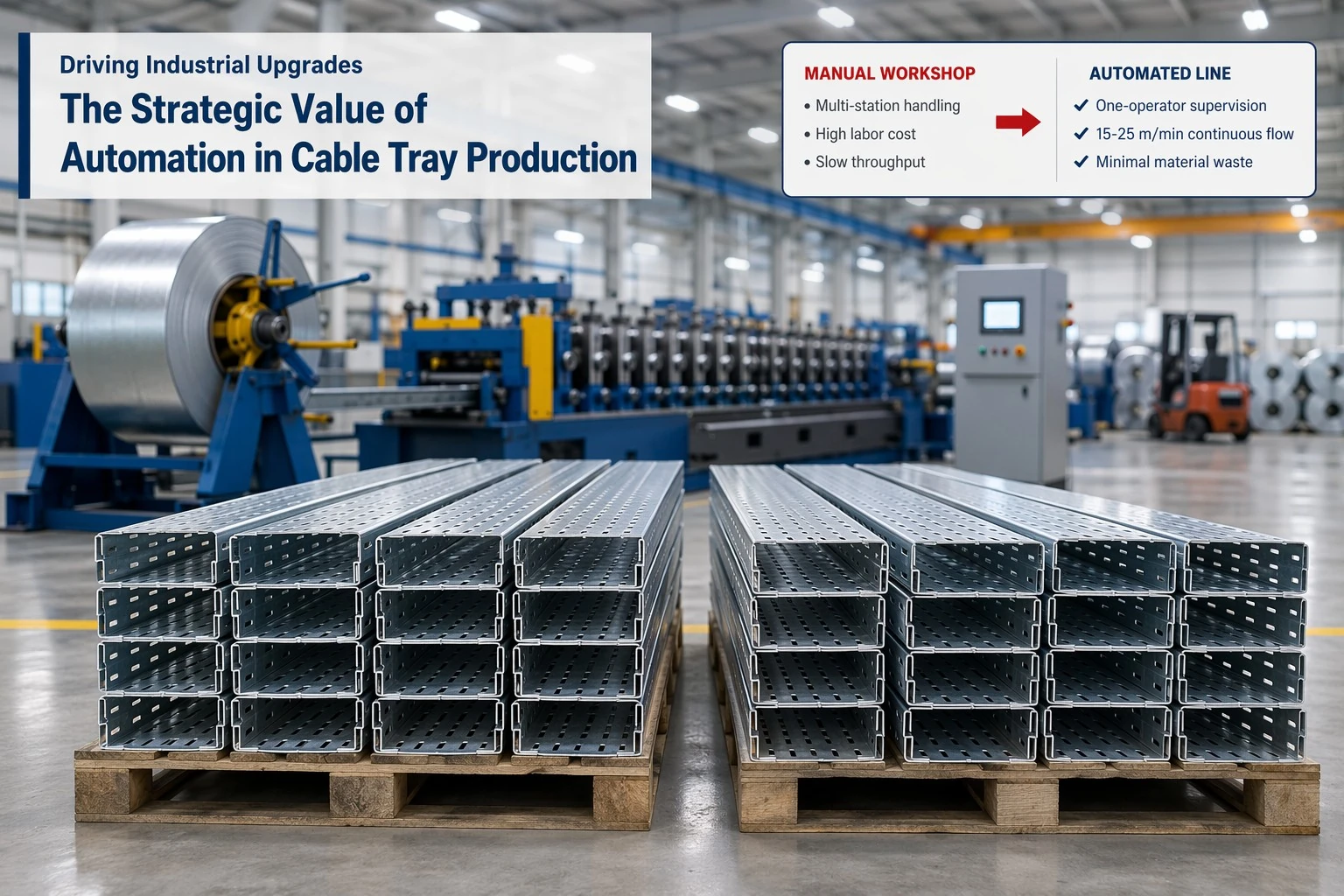
To truly understand the business impact, look at how automation redefines the core workflow of your factory floor operations:
Traditional Manual Workshop
In a traditional manual workshop, the process is highly fragmented and depends heavily on physical labor. Raw steel sheets must be moved by operators through multiple standalone stations—from manual shearing, to a standalone punching press, and finally to a press brake for bending. This setup requires multiple skilled operators, increases material handling risks, and inherently leads to a higher scrap rate.
Modern Automated Facility
In a modern automated facility, the entire process is condensed into a single continuous flow. Managed by a single supervisor, the line decoils, levels, punches, forms, and cuts the profile in one non-stop pass.
By reducing the production process down to a single supervisor who manages raw coil loading and monitors PLC diagnostics, your per-unit labor costs drop significantly. More importantly, you remove workers from hazardous proximity to heavy presses, creating a much safer, lower-risk workplace.
💡 The True Return on Investment
Beyond the immediate boost in output, automated production lines protect your bottom line by optimizing material yield. By using computer-calculated punching layouts, scrap steel waste is brought down to less than 1%. When dealing with thousands of tons of galvanized steel per year, these material savings alone can cover the machine's initial cost within months.
Future-Proof Your Manufacturing Business
The message from the global supply chain is clear: the future belongs to agile, high-efficiency, automated factories. Investing in a high-caliber automated cable tray machine is the definitive way to scale your capacity, lower your overhead, and dominate the market.
We engineer high-speed, custom roll forming systems tailored precisely to your localized profile specifications and volume targets.