In modern industrial and commercial construction, cable management is critical for safety, organization, and efficiency. Cable trays—the structural systems used to support insulated electrical cables—are the backbone of this infrastructure. To meet the massive global demand, manufacturers rely on automated, high-speed cable tray production lines (also known as cable tray roll forming machines).
If you are looking to invest in a cable tray manufacturing machine or want to optimize your current production, understanding its core machinery is essential. Below is a comprehensive breakdown of the main components of a high-efficiency cable tray production line.
1. De-Coiler (Uncoiler)
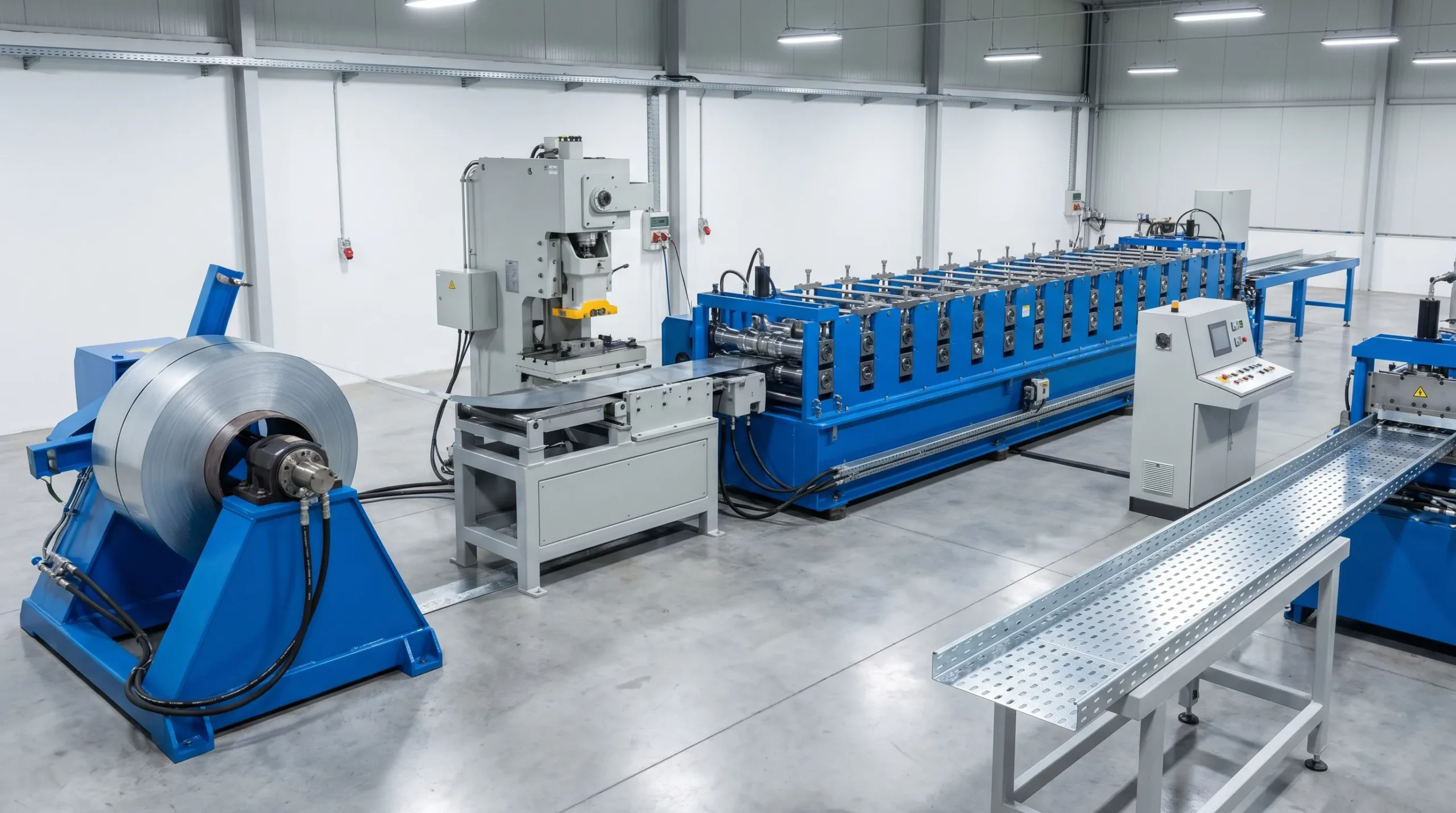
The production process begins with the De-coiler, which holds and safely unwinds the heavy metal coils (usually galvanized steel, stainless steel, or aluminum).
Function: It feeds the raw sheet metal into the production line smoothly and continuously.
Types: Depending on your automation needs, you can choose a manual de-coiler (for smaller operations) or a hydraulic de-coiler (for heavy-duty coils weighing 5 to 10 tons). Hydraulic variants often feature a coil car to speed up the loading process.
2. Leveling and Feeding Guide System
Raw metal coils often retain a “coil set” or curve from being rolled up. The leveling machine (or flattener) consists of multiple rollers that exert pressure on the sheet metal to remove stress and ensure it is perfectly flat before processing.
Why it matters: If the material is not perfectly level, subsequent punching and roll forming will be inaccurate, leading to warped or defective cable trays.
3. High-Speed Hydraulic Punching Press
One of the defining features of a cable tray is its pattern of holes, which are used for heat dissipation, drainage, and securing cables. This is where the hydraulic punching system comes into play.
Precision Tooling: Utilizing CNC programming, the punching press stamps out precise hole patterns, slots, and ventilation openings.
Adaptability: Advanced production lines feature adjustable or interchangeable punching dies, allowing manufacturers to switch between different hole configurations and tray widths effortlessly.
4. Cutting Mechanism (Pre-Cutting or Post-Cutting)
The line must cut the continuous metal sheet into specific lengths. Manufacturers generally choose between two methods:
Pre-cutting: The sheet is cut before it enters the roll forming machine.
Post-cutting (Fly-cutting): The sheet is cut after it has been shaped into a cable tray. A hydraulic tracking cut-off device is typically used here, meaning the blade moves along with the profile to cut it without stopping the entire line, drastically increasing production speed.
5. Roll Forming Machine (The Core Component)
The roll forming mill is the heart of the entire production line. It consists of a series of sequential rollers (passes) that gradually bend the flat, punched metal sheet into the desired cable tray profile (such as ladder types, perforated trays, or solid bottom trays).
Heavy-Duty Rollers: The rollers are precision-machined from high-grade steel (like Cr12 or GCr15), heat-treated, and chrome-plated for maximum wear resistance.
Width Adjustability: Because cable trays come in various sizes (e.g., widths from 100mm to 600mm), modern machines utilize an automatic width-changing system. Controlled by a PLC, the rollers can automatically move inward or outward to change sizes within minutes, minimizing downtime.
6. Hydraulic and Electrical Control System (PLC)
The brain of the cable tray production line is the PLC (Programmable Logic Controller) system, usually paired with a user-friendly touchscreen interface (HMI).
Automation: The operator simply inputs the desired tray length, batch quantity, and width into the panel. The PLC then synchronizes the feeding, punching, forming, and cutting speeds.
Brands: Premium lines integrate reliable global brands like Siemens, Mitsubishi, or Delta to ensure stable operations and easy troubleshooting.
7. Output Run-Out Table
Once the finished cable tray is formed and cut to length, it exits the machine onto the run-out table or receiving bracket. These tables can be simple manual racks or fully automated stacking systems designed to organize the finished products for packaging and shipping.
Key Benefits of an Automated Cable Tray Production Line
Investing in a high-quality roll forming line offers distinct competitive advantages:
High Efficiency: Production speeds can reach 10–15 meters per minute, seamlessly handling bulk orders.
Material Economy: Roll forming minimizes scrap metal compared to traditional press-brake bending.
Unmatched Accuracy: Tight tolerances ensure that every cable tray segment fits perfectly with connectors and accessories on the construction site.
A professional cable tray production line is a masterclass in synchronized engineering. From the heavy lifting of the de-coiler to the micro-precision of the PLC control and roll forming stations, each component plays a vital role in turning raw steel into a critical construction asset. For manufacturers looking to scale, choosing a line with automatic width adjustment and high-speed hydraulic punching is the key to maximizing ROI and staying ahead in the market.