The global push for modern infrastructure, smart grids, and renewable energy installations has driven the demand for high-quality cable management systems to an all-time high. For sheet metal manufacturers, this surge presents a massive gold rush. However, capitalizing on this opportunity requires more than just standard fabrication tools—it demands a state-of-the-art cable tray machine built for speed, precision, and endurance.
Purchasing a cable tray roll forming machine is a significant capital investment. To ensure your new equipment delivers a rapid return on investment (ROI) and keeps your production floor running smoothly, you must look beyond the price tag.
Here are the critical, high-performance engineering features you should prioritize when choosing your next production line.
1. On-Demand Dimension Changes: Motorized Width Adjustment
In traditional manufacturing setups, switching production from a 100mm wide cable tray to a 400mm alternative was a logistical nightmare. It required operators to manually dismantle the roller tooling, swap spacers, and realign the system—a tedious process taking up to four hours of idle time.
Top-tier roll forming machines solve this with fully automated, PLC-controlled width adjustment:
Instant Transitions: Operators simply type the new dimensions into the touchscreen interface.
Servo-Driven Precision: High-precision guide screws and motors automatically shift the forming rollers to their exact positions in under three minutes.
Unlocks Small-Batch Profitability: This feature allows you to accept diverse, short-run custom orders without sacrificing a full day of production to machine setup.
2. Flawless Alignment via Servo-Driven Hydraulic Punching
A cable tray's utility relies entirely on the accuracy of its ventilation slots and connection holes. If these holes are misaligned by even a millimeter, contractors will struggle to join the trays together on-site, leading to rejected batches and damaged client relationships.
High-end production lines prevent this by pairing a heavy-duty hydraulic punching station with a servo-motor material feeder.
Zero Cumulative Error: The servo system measures the metal strip with absolute precision, holding punching tolerances within a tight $pm0.5text$ margin.
Modular Die Designs: Premium machines feature quick-change punching dies, allowing you to switch slot patterns or add branding stamps with minimal fuss.
3. Industrial-Grade Rollers and Heavy-Duty Frame Construction
Because cable trays are designed to carry massive electrical loads, they are typically formed from thick, high-strength materials (often pre-galvanized or hot-rolled steel up to 3.0mm thick). Bending such heavy gauges places extreme stress on the machinery.
To prevent premature wear and machine flexing, look for these structural specifications:
Premium Roller Steel: Insist on rollers machined from Cr12MoV or GCr15 bearing steel, vacuum-hardened to $HRC58$–$62$. This guarantees the rollers won't wear down or scratch galvanized coatings.
Solid, Quenched Shafts: The rolling shafts should be crafted from solid 40Cr alloy, quenched and tempered to handle high torsional strain without bending.
Rigid Monoblock Frame: A heavy, welded steel plate structure (rather than bolted cast iron) absorbs high-speed vibrations and ensures decade-long alignment.
4. Non-Stop Cutting with Flying Shear Technology
A major bottleneck in low-end roll forming lines is the "stop-and-cut" cycle, where the metal strip must come to a complete halt for the hydraulic blade to slice it.
A high-performance line utilizes a flying hydraulic shear:
Continuous Motion: The cutting assembly moves dynamically alongside the profile, slicing the tray at full speed without stopping the line.
Clean, Burr-Free Edges: This dynamic cut prevents deformation of the tray ends, reducing post-production grinding labor and keeping your line moving at an optimal 15 to 25 meters per minute.
Machine Comparison: Premium vs. Standard Quality
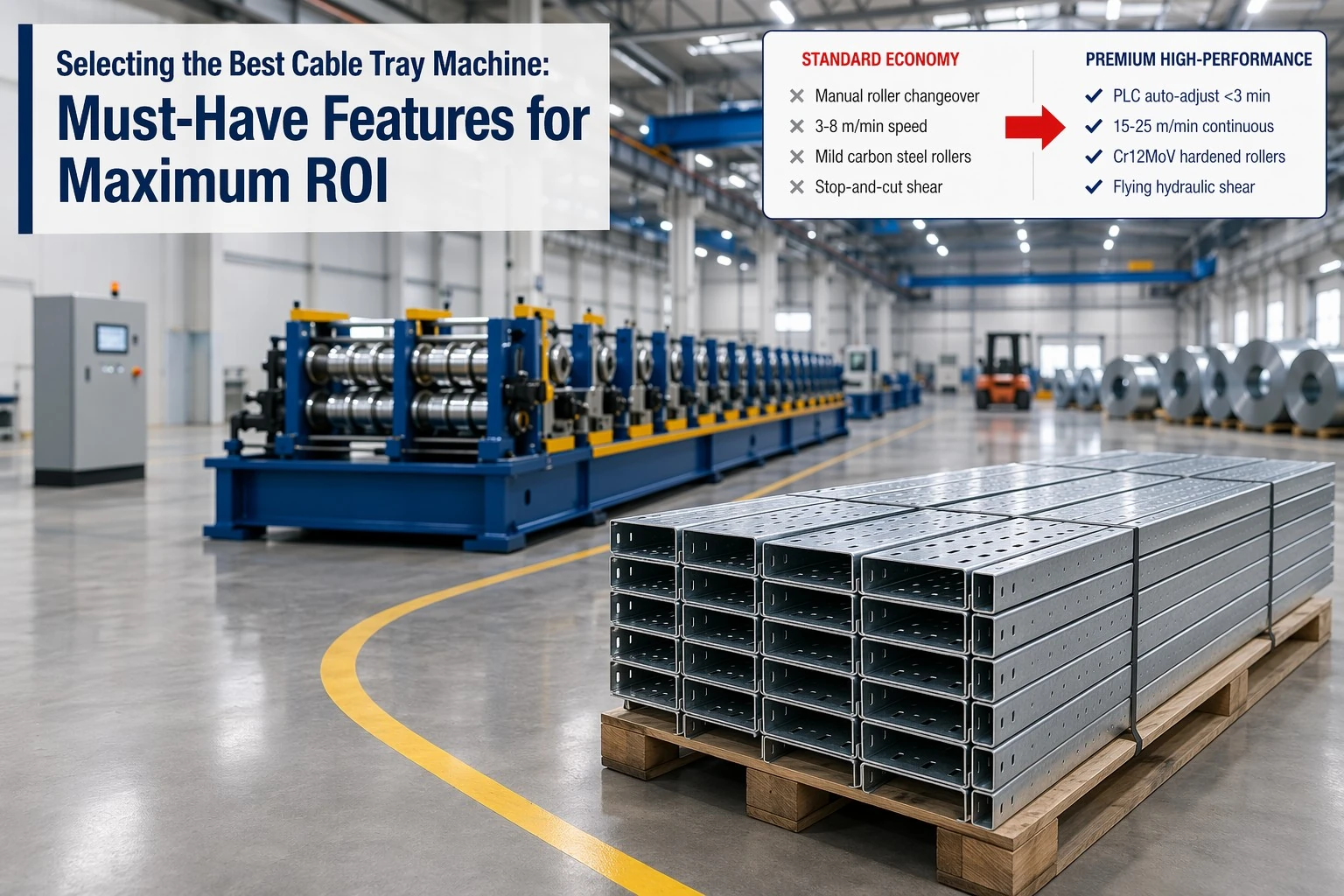
| Engineering Element | Standard Economy Machines | Premium High-Performance Lines |
| Size Adjustability | Manual spacer repositioning (2–4 hours) | Auto-motorized PLC adjustment (<3 minutes) |
| Output Speed | 3 to 8 meters per minute (intermittent) | 15 to 25 meters per minute (continuous) |
| Maximum Thickness | Standard gauges up to 1.5mm | Heavy-duty capacity up to 3.0mm |
| Tooling Material | Mild carbon steel (prone to rapid wear) | Hardened Cr12MoV/GCr15 tool steel |
| Cut-off System | Stop-and-shear (interrupts workflow) | Flying hydraulic shear (non-stop processing) |
5. Smart Control Systems and Built-In Safety Diagnostics
The brain of a modern production line is its control panel. High-performing systems are equipped with industry-recognized PLCs (like Siemens or Mitsubishi) integrated with user-friendly Human-Machine Interfaces (HMI).
These systems provide real-time diagnostic feedback, immediately pinpointing the exact location of any error (such as a material jam or pressure drop). Combined with physical safety barriers, light curtains, and emergency stops, they ensure your factory remains highly productive, safe, and fully compliant with international safety standards.
💡 Strategic Buyer Advice
When sourcing a roll forming line, always demand a factory acceptance test (FAT). Run your specified thickness and grade of steel at maximum speed to verify that the finished cable trays meet your structural and aesthetic standards before shipping.
Ready to Dominate the Containment Market?
Investing in a high-performance cable tray machine is the ultimate way to lower your cost-per-piece, eliminate manual rework, and secure large-scale commercial supply contracts.
We engineer customized, high-speed roll forming lines designed to match your exact regional profiles and production volumes.